

What is semantic SEO?
Semantic SEO is the process of optimizing content around search intent, entities, and contextual meaning instead of focusing only on keywords. It helps search engines understand relationships between topics, improving rankings in Google and AI-powered search systems.

Introduction
Search engines have evolved significantly over the last decade. Google no longer ranks pages purely based on keyword density.
Since the Hummingbird update (2013), Google has shifted toward understanding meaning rather than matching words.
With the introduction of:
Knowledge Graph
RankBrain
BERT
MUM
AI Overviews
Search is now powered by advanced Natural Language Processing (NLP).
This is where semantic SEO becomes essential.
What Is Semantic SEO?
Semantic SEO focuses on optimizing content around:
Search intent
Context
Entities
Topic relationships
User questions
Instead of targeting a single keyword repeatedly, semantic SEO builds topical depth and authority.
What Is Semantic SEO and How Does It Work?
Semantic SEO works by aligning content with how search engines interpret language using:
1. Natural Language Processing (NLP)
Google analyzes context and meaning, not just keywords.
2. Entity Recognition
Search engines identify people, brands, places, and concepts.
3. Knowledge Graph Connections
Google’s Knowledge Graph contains billions of entities and facts that connect related concepts.
4. Contextual Relevance
Google evaluates how comprehensively a topic is covered.
Evolution of Semantic Search (Google Updates)
Knowledge Graph (2012)
Introduced entity relationships into search.
Hummingbird (2013)
Improved conversational search understanding.
RankBrain (2015)
Machine learning ranking system.
BERT (2019)
Improved contextual interpretation of queries.
MUM (2021)
Multimodal understanding across text and images.
AI Overviews (2024+)
Generative AI answers directly in SERPs.
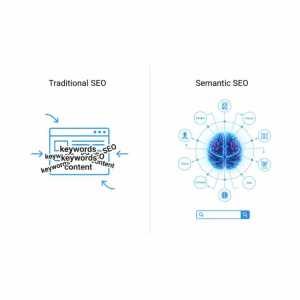
Semantic SEO vs Traditional SEO Difference
| Factor | Traditional SEO | Semantic SEO |
|---|---|---|
| Focus | Keywords | Search intent & entities |
| Content Depth | Basic | Comprehensive topic coverage |
| AI Optimization | Low | High |
| Structure | Page-based | Topic cluster-based |
| Google AI Overview | Rare | Higher inclusion chance |
Direct Answer:
Semantic SEO outperforms traditional SEO in 2026 because AI-powered search engines prioritize meaning over keyword repetition.
Semantic SEO Examples for Beginners
Example 1: Traditional SEO
Keyword: “best laptops”
Content repeats the phrase multiple times.
Example 2: Semantic SEO
Content includes:
Best laptops for students
Gaming laptops
Processor comparison
RAM requirements
SSD vs HDD
Buying guide
FAQs
This creates topical completeness.
Entity Based SEO Strategy for Small Businesses
Entity-based SEO focuses on optimizing around recognized concepts.
Step 1: Identify Core Entity
Example: Digital Marketing Agency
Step 2: Identify Related Entities
SEO
PPC
Content Marketing
Conversion Optimization
Analytics
Step 3: Build Topic Clusters
Create:
Pillar page
Supporting blogs
Case studies
FAQs
Step 4: Add Structured Data
Implement:
FAQ Schema
Article Schema
Organization Schema
How to Implement Semantic SEO Strategy in 2026 (Step-by-Step)
Step 1: Understand Search Intent
Is the query informational, transactional, or navigational?
Step 2: Perform Entity Research
Use:
Google Autocomplete
People Also Ask
Related Searches
Step 3: Build Content Clusters
Structure content into pillar + supporting posts.
Step 4: Cover Subtopics Deeply
Include:
Definitions
Comparisons
Statistics
Examples
FAQs
Step 5: Optimize for AI Overviews
Add short definition blocks
Use structured headings
Keep answers concise
Step 6: Add Internal Linking
Example:
[AI-First SEO Strategy Guide]
[SEO Checklist for Small Businesses]
Semantic SEO Checklist for Blog Posts
Before publishing, ensure:
Primary keyword in H1
Definition paragraph under H1
Search intent satisfied
Entities clearly explained
Comparison table included
FAQ section added
Internal links added
External references added
Short answer blocks included
Semantic SEO for AI Search Engines
AI search engines such as:
ChatGPT
Gemini
Perplexity
Claude
Copilot
Extract structured, well-defined content.
To optimize:
Use clear definitions
Add tables
Avoid vague explanations
Use entity relationships
Structure content logically
Semantic SEO for Google AI Overview
To improve inclusion in AI Overviews:
Answer questions directly
Use structured formatting
Provide expert-level depth
Include data-backed explanations
Avoid thin content
Semantic SEO and Generative AI Optimization
Generative AI optimization (GEO) focuses on:
Context clarity
Logical flow
Entity relationships
Structured formatting
Semantic SEO supports AI by making content easier to extract, summarize, and cite.
Future of Semantic SEO (2026 & Beyond)
By 2026:
AI-driven search results dominate
Conversational search increases
Entity-based indexing strengthens
Topic authority becomes critical
SEO is evolving from keyword optimization to knowledge optimization.
Frequently Asked Questions (FAQ)
What is semantic SEO and how does it work?
Semantic SEO optimizes content around meaning, entities, and search intent instead of focusing only on keywords. It works by aligning content with NLP models like BERT and Google’s Knowledge Graph to improve contextual relevance.
Is semantic SEO better than traditional SEO?
Yes. Semantic SEO performs better in modern search because it builds topic depth and aligns with AI-driven ranking systems.
How do I optimize for AI search engines?
Use structured content, concise answers, entity-based explanations, and comparison tables to make content AI-friendly.
What is entity-based SEO?
Entity-based SEO focuses on optimizing content around recognized concepts connected within Google’s Knowledge Graph.
Does semantic SEO help with Google AI Overview?
Yes. Structured, context-rich content increases the chances of being included in AI-generated search summaries.
Conclusion
Semantic SEO is the foundation of modern search visibility.
If you want to:
Rank in Google
Appear in AI Overviews
Be cited by AI tools
Build topical authority
You must focus on meaning, entities, and structured knowledge — not just keywords.
Leave a Reply