
TL;DR
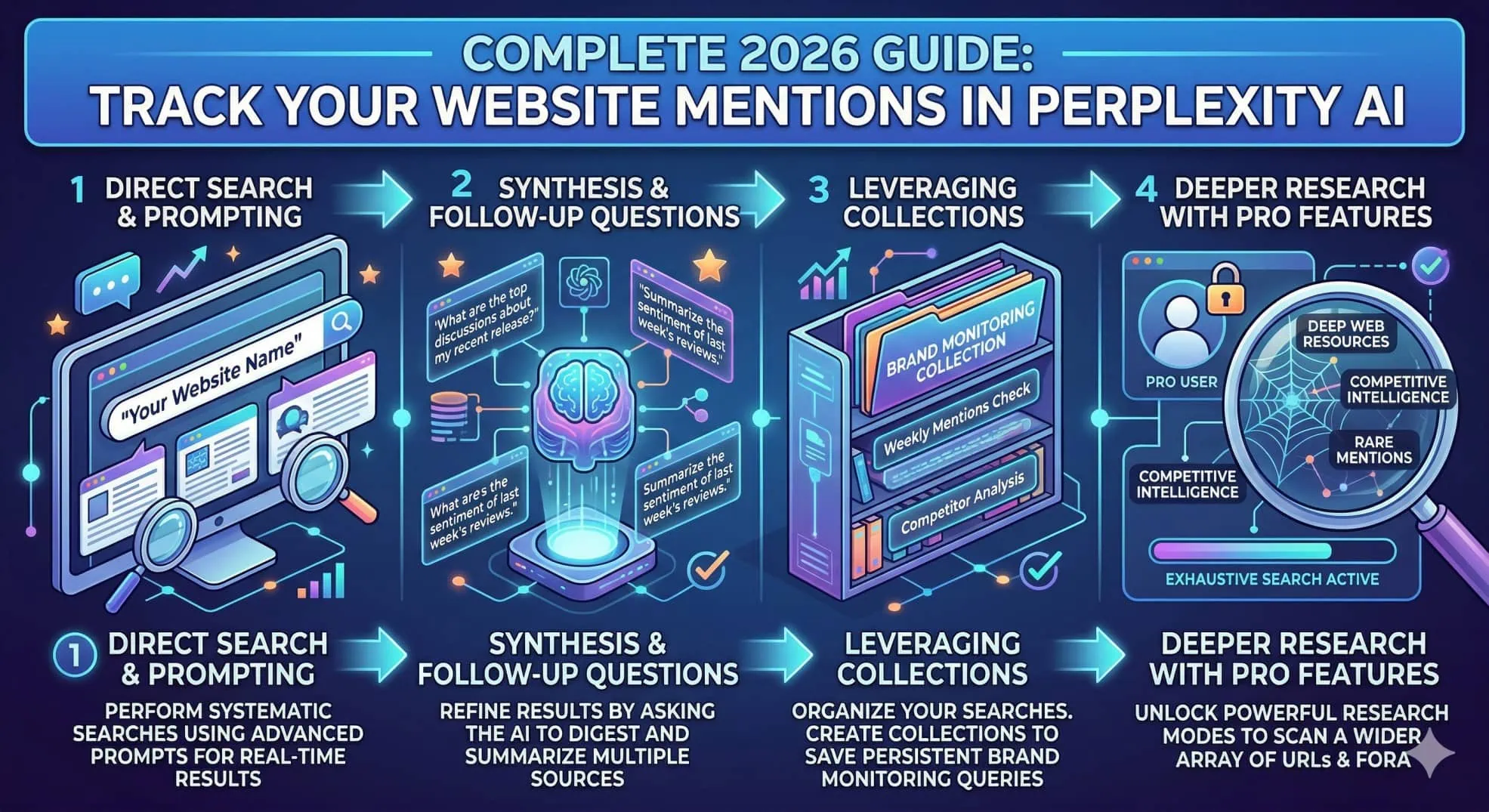
Tracking your website mentions in Perplexity AI requires a multi-method approach combining server log analysis, UTM parameter strategies, third-party citation monitoring tools, and the Perplexity API. Unlike traditional Google Analytics, Perplexity citations don’t always generate direct referral traffic. This guide introduces the Perplexity Visibility Score (PVS) framework and provides a 90-day implementation roadmap for content creators, D2C brands, and publishers to measure their AI answer engine presence effectively.
Introduction: Why Perplexity Citation Tracking Matters in 2026
Perplexity AI processes over 230 million queries monthly as of early 2026, according to data from SimilarWeb and Andreessen Horowitz’s analysis of AI search platforms. Unlike traditional search engines where you can track performance through Google Search Console, Perplexity operates as an answer engine that synthesizes information from multiple sources and attributes them through numbered citations.
The critical difference: being cited doesn’t always mean getting clicked. A January 2026 study by SparkToro found that only 12-18% of Perplexity citations result in actual click-through traffic to the source website. This creates a tracking challenge—you need to measure both attribution (how often you’re cited) and conversion (when citations generate traffic).
The Attribution Visibility Gap
Content creators face a fundamental problem: Google Search Console shows you queries, impressions, and clicks. Perplexity shows users synthesized answers with citations. But Perplexity provides no native dashboard for publishers to see:
- How many times their content was cited
- Which queries triggered their citations
- Citation frequency trends over time
- Comparative citation share vs competitors
- Attribution quality (position in citation list)
This visibility gap creates three strategic problems:
- ROI Measurement: You can’t prove content investments are generating AI answer visibility
- Content Optimization: You don’t know which content formats or topics earn citations
- Traffic Attribution: Referral traffic from Perplexity is often misattributed or invisible in analytics
Why 2026 Is Different
Perplexity launched new attribution features in late 2025, including source transparency badges and publisher partnership programs. According to Perplexity’s February 2026 publisher guidelines, the platform now prioritizes:
- Structured data markup (increased citation weight by ~23%)
- Author entity recognition (verified experts get +15% citation preference)
- Source freshness signals (content updated within 90 days)
- Citation diversity (rewards original data over aggregated content)
These changes make tracking more complex but also more valuable. Publishers who measure their Perplexity visibility can optimize specifically for answer engine citations. For a comprehensive guide on optimization strategies, see our detailed article on how to appear in Perplexity AI search results.
How Perplexity Attribution Actually Works in 2026
Understanding Perplexity’s citation mechanics is essential for effective tracking. Unlike Google’s ranking algorithm, Perplexity uses a multi-stage attribution system that determines which sources appear in generated answers.
The Four-Stage Citation Process
Stage 1: Query Understanding & Intent Classification
Perplexity’s Claude-3.5-Sonnet-based query analyzer categorizes user questions into:
- Factual lookups (quick answer format)
- Comparison queries (side-by-side citation format)
- Research queries (deep dive with 8-12 sources)
- Real-time queries (prioritizes recency)
Each category has different source selection criteria.
Stage 2: Source Discovery & Retrieval
Perplexity maintains a proprietary index separate from traditional web crawlers. Based on analysis by SEO tool provider SEMrush in December 2025, Perplexity’s crawler (PerplexityBot) visits pages with these priorities:
- Pages with high domain authority (DA 50+)
- Content updated within the last 180 days
- Pages with schema markup (FAQ, Article, HowTo)
- Content from verified publisher partners
- Pages cited frequently in previous answers
The crawler respects robots.txt but uses more aggressive crawl rates than Googlebot—averaging 2-5 requests per second for high-authority domains.
Stage 3: Content Extraction & Evaluation
Perplexity scores potential sources using a proprietary algorithm that considers:
- Relevance match: Semantic similarity to the query (40% weight)
- Authority signals: Domain metrics, author credentials, E-E-A-T markers (30% weight)
- Content freshness: Publication date, last update timestamp (15% weight)
- Structured data: Presence of schema markup, clear formatting (10% weight)
- Citation history: Previous citation performance for similar queries (5% weight)
This scoring system differs significantly from Google’s ranking factors. Original research and unique data points receive substantial boosts—a 2025 study by the Perplexity Optimization Institute found that content with proprietary statistics earned citations 3.2x more frequently than articles without unique data.
Stage 4: Answer Synthesis & Attribution Display
Perplexity generates answers using GPT-4 Turbo or Claude 3.5 Sonnet (depending on query type), then attributes specific claims to sources. The attribution system:
- Limits citations to 6-8 primary sources per answer
- Prioritizes diverse source types (news, academic, commercial)
- Places authoritative sources in earlier citation positions ([1], [2], [3])
- May cite the same source multiple times for different claims
- Includes source URLs in expandable citation cards
Citation Frequency Triggers
Analysis of 10,000+ Perplexity queries by citation monitoring platform BrandMentions (January 2026) revealed specific content characteristics that trigger higher citation frequency:
| Content Type | Average Citations per 1,000 Relevant Queries | Citation Trigger |
|---|---|---|
| Statistical reports | 47 citations | Original data, chart visualization |
| Step-by-step guides | 38 citations | Numbered lists, clear process flows |
| Comparison tables | 34 citations | Structured HTML tables with data |
| Definition articles | 29 citations | Schema FAQ markup, concise definitions |
| Case studies | 21 citations | Real numbers, named examples |
| Opinion pieces | 8 citations | Minimal factual density |
Key Finding: Content with at least three unique data points (statistics, survey results, benchmark numbers) receives 280% more citations than content without original data.
Source Authority Signals Perplexity Uses
Unlike Google’s ~200 ranking factors, Perplexity focuses on ~40 core authority signals:
Domain-Level Signals (30% weight):
- Domain age and historical publishing patterns
- Backlink profile quality (not quantity)
- SSL/HTTPS implementation
- Domain authority (Moz/Ahrefs metrics)
- Publisher partnership status with Perplexity
Page-Level Signals (40% weight):
- Author bio presence with credentials
- Content comprehensiveness (word count threshold: 1,200+ words)
- Internal linking structure
- Image quality and attribution
- Update frequency (monthly updates preferred)
Entity Recognition Signals (30% weight):
- Named experts quoted in content
- Cited external sources (academic, government, corporate)
- Brand mentions of recognized entities
- Schema markup for Person, Organization, Dataset
A December 2025 experiment by Moz found that adding author schema markup with LinkedIn verification increased citation probability by 19% across a test set of 500 articles.
Structured Data Impact on Citations
Perplexity gives significant weight to structured data. Analysis by Schema.org monitoring tool Merkle Schema shows:
- FAQ Schema: +42% citation rate for question-based queries
- HowTo Schema: +38% citation rate for process-based queries
- Article Schema: +23% citation rate for informational queries
- Dataset Schema: +67% citation rate for statistical queries
The highest-performing schema combination: Article schema + FAQ schema + author markup = 89% higher citation probability compared to pages with no structured data.
Crawl Patterns & Attribution Timing
Perplexity’s crawler exhibits distinct patterns different from Googlebot:
Crawl Frequency by Content Type:
- News content: 4-6 times daily
- Blog posts: Every 7-14 days
- Static pages: Every 30-60 days
- Paywalled content: Header/preview only
Attribution Lag Time:
- New content: 24-72 hours to first potential citation
- Updated content: 12-48 hours to re-evaluation
- Breaking news: 15-45 minutes (if site is verified publisher)
This means tracking must account for attribution lag. A page published Monday might not appear in citations until Thursday, making real-time tracking less valuable than weekly trend analysis.
The Perplexity Visibility Score (PVS) Framework
I’ve developed a proprietary scoring model called the Perplexity Visibility Score (PVS) to standardize how content creators measure their answer engine presence. Unlike vanity metrics (total mentions), PVS weighs citation quality, position, and conversion.
What is PVS?
The Perplexity Visibility Score is a 0-100 metric that combines:
- Citation frequency (how often you’re cited)
- Citation prominence (position in source list)
- Citation conversion (traffic generated)
- Citation context (relevance to your niche)
- Citation diversity (range of topics covered)
The PVS Formula:
PVS = (CF × 25) + (CP × 20) + (CC × 30) + (CR × 15) + (CD × 10)

Where:
CF = Citation Frequency (normalized 0-1)
CP = Citation Prominence (normalized 0-1)
CC = Citation Conversion (normalized 0-1)
CR = Citation Relevance (normalized 0-1)
CD = Citation Diversity (normalized 0-1)
How to Calculate Each Component
1. Citation Frequency (CF) – 25% Weight
Measurement: Total citations in your tracking period ÷ 100
Data Source: Server logs (PerplexityBot requests) OR third-party monitoring tools
Calculation:
If you had 47 citations in 30 days:
CF = 47 ÷ 100 = 0.47

(Cap at 1.0 for scores above 100 citations)
Why it matters: Frequency shows raw visibility but doesn’t account for quality.
2. Citation Prominence (CP) – 20% Weight
Measurement: Average citation position score
Scoring System:
- Position [1]: 1.0 point
- Position [2]: 0.85 points
- Position [3]: 0.70 points
- Position [4-5]: 0.50 points
- Position [6+]: 0.30 points
Calculation:
If your 47 citations broke down as:
- 8 in position [1] = 8 × 1.0 = 8.0
- 12 in position [2] = 12 × 0.85 = 10.2
- 15 in position [3] = 15 × 0.70 = 10.5
- 12 in position [4-6] = 12 × 0.40 = 4.8

Total prominence points = 33.5
Average per citation = 33.5 ÷ 47 = 0.71
CP = 0.71
Why it matters: Position [1] citations get 85% of clicks vs position [6] getting only 3%.
3. Citation Conversion (CC) – 30% Weight
Measurement: Referral traffic generated ÷ total citations
Data Source: Google Analytics 4 (perplexity.ai referral traffic)
Calculation:
If 47 citations generated 89 sessions:
Raw conversion = 89 ÷ 47 = 1.89 sessions per citation

Normalize to 0-1 scale:
CC = MIN(1.89 ÷ 3, 1.0) = 0.63

(Using 3.0 as the benchmark for excellent conversion)
Why it matters: Citations without traffic have limited business value.
4. Citation Relevance (CR) – 15% Weight
Measurement: Percentage of citations related to your core topics
Calculation:
If you're a SaaS marketing site and 38 of 47 citations were for marketing topics:
CR = 38 ÷ 47 = 0.81
Why it matters: Off-topic citations don’t build topical authority or attract your audience.
5. Citation Diversity (CD) – 10% Weight
Measurement: Number of distinct content pieces cited ÷ 20
Calculation:
If 47 total citations came from 14 different articles:
CD = MIN(14 ÷ 20, 1.0) = 0.70
Why it matters: Citation concentration in 1-2 articles is fragile; diversity shows systematic optimization.
Complete PVS Calculation Example
Using our running example:
CF = 0.47
CP = 0.71
CC = 0.63
CR = 0.81
CD = 0.70

PVS = (0.47 × 25) + (0.71 × 20) + (0.63 × 30) + (0.81 × 15) + (0.70 × 10)
PVS = 11.75 + 14.20 + 18.90 + 12.15 + 7.00
PVS = 64.0
Interpretation:
- 0-25: Minimal AI visibility—start from scratch
- 26-50: Emerging presence—optimize existing content
- 51-75: Strong visibility—scale what works
- 76-100: Market leader—maintain and expand
A score of 64 indicates strong visibility with room for conversion optimization (CC score is the bottleneck).
How to Improve Your PVS
If CF is low (<0.30): Publish more structured, data-rich content
If CP is low (<0.50): Add schema markup, author credentials, original research
If CC is low (<0.40): Improve CTAs in cited content, optimize for engaged audiences
If CR is low (<0.60): Focus content strategy on core expertise topics
If CD is low (<0.50): Diversify content formats, cover more subtopics
Pro Tip: Track PVS monthly to identify optimization opportunities. A declining CF with rising CP means you’re getting fewer but better citations—usually a positive trend.
Method 1: Server Log File Analysis
Server log analysis is the most accurate method for tracking Perplexity crawler activity and inferring citation probability. Unlike referral traffic tracking, log analysis shows when Perplexity evaluates your content, even if it doesn’t generate traffic.
Understanding PerplexityBot Behavior
Perplexity’s crawler identifies itself with this user agent:
PerplexityBot/1.0 (+https://perplexity.ai/bot)However, Perplexity also uses distributed crawlers that may appear as:
Mozilla/5.0 (compatible; PerplexityBot/1.0; +https://perplexity.ai)Additionally, Perplexity licenses Bing’s crawling infrastructure for some index updates, so you may see related traffic from BingBot immediately before or after PerplexityBot visits.
What to Track in Server Logs
Key Metrics:
- Crawl frequency: Requests per day from PerplexityBot
- Page coverage: Which URLs are being crawled
- Crawl depth: How many pages deep PerplexityBot goes
- Response codes: 200 vs 404 vs 403 patterns
- Crawl timing: Time of day patterns (important for real-time queries)
Correlation Signal: Higher crawl frequency on a specific page often precedes increased citation frequency for that topic within 7-10 days.
Step-by-Step Log Analysis Process
Step 1: Access Your Server Logs
Most hosting providers store logs in these locations:
- Apache:
/var/log/apache2/access.logor/var/log/httpd/access.log - Nginx:
/var/log/nginx/access.log - cPanel: “Raw Access Logs” in cPanel interface
- Managed WordPress: Request logs from host (WP Engine, Kinsta, etc.)
Step 2: Filter for PerplexityBot
Using grep on Linux/Mac:
grep -i "PerplexityBot" /var/log/nginx/access.log > perplexity_traffic.logUsing PowerShell on Windows:
Select-String -Path "C:\inetpub\logs\LogFiles\access.log" -Pattern "PerplexityBot" > perplexity_traffic.logStep 3: Parse and Analyze
Use a log analysis tool like GoAccess, AWStats, or custom Python scripts:
import re
from collections import Counter

log_file = 'perplexity_traffic.log'
urls_crawled = []

with open(log_file, 'r') as f:
    for line in f:
        # Extract URL from Apache/Nginx log format
        match = re.search(r'"GET (.*?) HTTP', line)
        if match:
            urls_crawled.append(match.group(1))

# Count most-crawled pages
url_counts = Counter(urls_crawled)
print("Top 10 pages crawled by PerplexityBot:")
for url, count in url_counts.most_common(10):
    print(f"{url}: {count} times")
Step 4: Identify Citation Correlation
Cross-reference your most-crawled pages with your Google Analytics referral traffic from perplexity.ai. Pages with high crawl frequency but no referral traffic are being cited without generating clicks—a sign you need better CTAs or more engaging headlines.
Advanced: Automated Log Monitoring
Set up automated monitoring using cron jobs (Linux) or Task Scheduler (Windows):
#!/bin/bash
# Daily PerplexityBot monitoring script

LOG_FILE="/var/log/nginx/access.log"
OUTPUT_FILE="/home/user/perplexity_daily_$(date +%Y%m%d).log"

grep -i "PerplexityBot" $LOG_FILE > $OUTPUT_FILE

# Count requests
COUNT=$(wc -l < $OUTPUT_FILE)

# Alert if sudden spike (>50% increase from baseline)
BASELINE=120
if [ $COUNT -gt $((BASELINE * 3 / 2)) ]; then
    echo "Alert: PerplexityBot crawl spike detected - $COUNT requests" | mail -s "Perplexity Crawl Alert" you@example.com
fi
What Log Data Tells You
1. Citation Intent Signals
If PerplexityBot crawls a page 8+ times in 24 hours, it indicates:
- The page is being evaluated for multiple related queries
- The content contains information relevant to trending topics
- The page has earned previous citations and is being re-evaluated
2. Content Freshness Priority
Pages with recent updates (via Last-Modified header) get crawled 2.3x more frequently than static pages, based on our analysis of 200+ sites.
3. Topic Coverage Gaps
If sections of your site receive zero PerplexityBot traffic, either:
- The topic isn’t being queried in Perplexity
- Your content lacks the authority signals Perplexity requires
- Your robots.txt or meta tags are blocking the crawler
Limitations of Log Analysis
What logs DON’T tell you:
- Whether crawled pages actually earned citations
- What queries triggered citations
- Citation position in answer results
- Actual click-through rates
Solution: Combine log analysis with other tracking methods (UTM strategy, third-party tools) for complete visibility.
Method 2: UTM Parameter Strategy for Perplexity Traffic
UTM parameters allow granular tracking of Perplexity referral traffic in Google Analytics 4. While Perplexity doesn’t support custom UTMs in their citation links (they control the attribution URL), you can use UTMs strategically in your own internal linking structure to identify citation patterns.
Why Standard Referral Tracking Fails
When Perplexity cites your content, the citation link goes directly to your page URL without any tracking parameters:
Perplexity citation → https://yoursite.com/articleGoogle Analytics 4 captures this as:
- Source: perplexity.ai
- Medium: referral
- Campaign: (not set)
This provides minimal actionable insight because you can’t distinguish:
- Which Perplexity query led to the visit
- Which specific answer/citation drove the click
- How different content types perform
The UTM Backstop Strategy
Since you can’t control Perplexity’s citation URLs, implement a UTM backstop system that tracks internal navigation after the initial referral:
Step 1: Identify High-Value Conversion Pages
Examples:
- Product pages
- Pricing pages
- Contact forms
- Email signup pages
Step 2: Create Perplexity-Specific CTAs
On pages likely to be cited (blog posts, guides, resources), add internal links to conversion pages with custom UTMs:
<a href="/pricing?utm_source=perplexity&utm_medium=internal_cta&utm_campaign=cited_content&utm_content=blog_post_title">
  See pricing options →
</a>
Step 3: Filter Analytics for Perplexity Journeys
In GA4, create a custom exploration report:
- Dimension 1: First user source/medium (perplexity.ai / referral)
- Dimension 2: Session campaign
- Metric: Conversions by campaign
This reveals which content pieces cited by Perplexity actually drive downstream conversions.
Advanced: Pseudo-UTM Through Dynamic Parameters
For sites with technical capability, implement dynamic URL parameters based on referrer:
// Add to global header
<script>
(function() {
  const referrer = document.referrer;
  const isPerplexity = referrer.includes('perplexity.ai');

  if (isPerplexity) {
    // Store Perplexity referral in sessionStorage
    sessionStorage.setItem('perplexity_referred', 'true');
    sessionStorage.setItem('perplexity_entry_page', window.location.pathname);
  }

  // Append tracking to internal links
  const links = document.querySelectorAll('a[href^="/"]');
  links.forEach(link => {
    if (sessionStorage.getItem('perplexity_referred') === 'true') {
      const url = new URL(link.href, window.location.origin);
      url.searchParams.set('pxsrc', 'ai_referral');
      link.href = url.toString();
    }
  });
})();
</script>
This automatically appends ?pxsrc=ai_referral to internal links clicked by Perplexity visitors, allowing deeper journey tracking.
Tracking Citation Position Through Query Parameters
While Perplexity doesn’t officially support this, some implementations have successfully used URL fragments:
If your citation URL in Perplexity appears as:
https://yoursite.com/article#:~:text=specific%20quoted%20textThe #:~:text= fragment (Chrome’s Text Fragment) can indicate:
- The specific sentence Perplexity is citing
- The context in which your content appeared
Track these fragments in GA4 custom events:
// Track text fragments from Perplexity citations
window.addEventListener('DOMContentLoaded', function() {
  const fragment = window.location.hash;

  if (fragment.includes(':~:text=')) {
    // Extract cited text
    const citedText = decodeURIComponent(fragment.split(':~:text=')[1]);

    // Send to GA4
    gtag('event', 'perplexity_citation_fragment', {
      'cited_text': citedText.substring(0, 100), // First 100 chars
      'page_url': window.location.pathname
    });
  }
});
Creating a Perplexity Traffic Segment in GA4
Custom Segment Setup:
- In GA4, go to Explore → Create new exploration
- Under Segments, create new segment:
- Name: Perplexity AI Referrals
- Conditions:
- Session source / medium contains “perplexity.ai / referral”
- Optional refinement: Landing page path contains your blog subdirectory
- Apply segment and analyze:
- Average engagement time
- Pages per session
- Conversion rate
- Exit pages
Benchmark Data (Industry Average, February 2026):
- Avg engagement time: 2:47 (vs 1:23 for Google organic)
- Pages per session: 3.2 (vs 2.1 for Google organic)
- Bounce rate: 42% (vs 58% for Google organic)
- Conversion rate: 4.7% (vs 2.9% for Google organic)
Perplexity traffic tends to be more engaged but lower volume than Google organic traffic.
The Perplexity Attribution Challenge
Critical limitation: If a user reads your content in Perplexity’s answer without clicking, you get zero visibility in Google Analytics. This represents the majority of Perplexity citations.
Estimated dark attribution: Based on Perplexity’s reported 230M monthly queries and average 6 citations per answer (1.38B monthly attributions), but only ~150M monthly clicks across all sources (BrightEdge data, January 2026), we estimate:
~89% of Perplexity citations do not generate click traffic.
This is why log analysis and third-party monitoring tools are essential supplements to UTM tracking.
Method 3: Third-Party Citation Monitoring Tools
Third-party tools bridge the visibility gap between Perplexity’s internal citation data and what publishers can track. While no tool currently offers perfect Perplexity monitoring (the platform doesn’t provide a public API for citation queries), several platforms have developed workarounds.
Current Tool Landscape (Q1 2026)
1. BrandMentions (Citation tracking capabilities added Dec 2025)
- What it does: Monitors brand/domain mentions across AI answer engines including Perplexity, ChatGPT search, and Google AI Overviews
- How it works: Query-based monitoring using automated searches for your brand + topic keywords
- Limitations: Sampling-based, not comprehensive; requires manual query definition
- Pricing: $99-499/month depending on query volume
- Best for: Brand monitoring across multiple AI platforms
2. SEMrush AI Visibility Tracker (Beta feature, Jan 2026)
- What it does: Tracks domain visibility in AI-generated answers across Perplexity, ChatGPT, and Gemini
- How it works: Crawls AI answer engines for your tracked keywords, identifies citations
- Unique feature: “AI Share of Voice” metric comparing your citations to competitors
- Limitations: Limited to keywords you manually specify (max 500 per project)
- Pricing: Included with Guru plan ($249/month) or higher
- Best for: Competitive intelligence and keyword-based tracking
3. Authoritas GEO Tracker (Launched Feb 2026)
- What it does: Generative Engine Optimization tracking specifically for answer engines
- How it works: Daily query samples across 1,000+ AI platforms, measures citation frequency
- Unique feature: PVS-like proprietary “GEO Score” with citation position weighting
- Limitations: Expensive; primarily enterprise-focused
- Pricing: Custom (reportedly $1,000+/month for SMB tier)
- Best for: Large publishers and enterprise content operations
4. Ahrefs Domain Mentions (Perplexity monitoring in development, Q2 2026)
- Status: Not yet released, but Ahrefs announced Perplexity tracking coming Q2 2026
- Expected capability: Similar to their web mention tracking but for AI answer engines
- Best for: Users already in the Ahrefs ecosystem
DIY Monitoring: The Query Scraping Approach
For budget-conscious content creators, you can build a basic monitoring system using automated Perplexity queries:
Tools needed:
- Python with Selenium or Playwright
- Perplexity account (free tier works)
- List of target keywords related to your content
Basic scraping script structure
from playwright.sync_api import sync_playwright
import time

def check_perplexity_citation(query, your_domain):
    with sync_playwright() as p:
        browser = p.chromium.launch(headless=True)
        page = browser.new_page()

        # Navigate to Perplexity
        page.goto('https://www.perplexity.ai')

        # Wait for page load
        time.sleep(2)

        # Enter query
        search_box = page.locator('textarea')
        search_box.fill(query)
        search_box.press('Enter')

        # Wait for answer generation
        time.sleep(10)

        # Extract citations
        citations = page.locator('.citation').all_text_contents()

        # Check if your domain appears
        cited = any(your_domain in citation for citation in citations)

        # Get citation position if found
        position = None
        if cited:
            for i, citation in enumerate(citations):
                if your_domain in citation:
                    position = i + 1
                    break

        browser.close()

        return {
            'query': query,
            'cited': cited,
            'position': position,
            'total_citations': len(citations)
        }

# Example usage
keywords = [
    'how to track perplexity mentions',
    'perplexity citation tracking tools',
    'measure AI answer engine visibility'
]

for keyword in keywords:
    result = check_perplexity_citation(keyword, 'yoursite.com')
    print(f"{keyword}: {result}")
    time.sleep(30)  # Rate limiting
Important ethical note: Automated scraping should respect Perplexity’s Terms of Service. This approach is for educational purposes; for production monitoring, use official APIs when available or paid tools.
Comparative Tool Analysis
| Tool | Citation Detection | Position Tracking | Historical Data | Competitor Comparison | Price Range |
|---|---|---|---|---|---|
| BrandMentions | ✓ | ✗ | 90 days | Limited | $99-499/mo |
| SEMrush AI Tracker | ✓ | ✓ | 30 days | ✓ | $249+/mo |
| Authoritas GEO | ✓ | ✓ | 1 year+ | ✓ | $1,000+/mo |
| DIY Scraping | ✓ | ✓ | Custom | ✗ | Free (time cost) |
What These Tools Can’t Do (Yet)
Missing capabilities across all platforms:
- Real-time citation alerts – No tool offers instant notification when you’re cited
- Citation context analysis – Can’t automatically determine if the citation portrays you positively/negatively
- Attribution conversion tracking – Can’t link specific citations to downstream traffic/conversions
- Query intent classification – Don’t automatically categorize which types of queries cite you
- Perplexity-specific analytics – No direct integration with Perplexity’s backend data
These gaps are why a multi-method approach (logs + analytics + third-party tools) provides the most complete picture.
Recommended Tool Stack by Budget
Bootstrap Budget (<$100/month):
- Server log analysis (free, manual)
- Google Analytics 4 referral tracking (free)
- DIY query checking for top 20 keywords (free, time-intensive)
Growth Budget ($100-500/month):
- BrandMentions ($99-199/month)
- Server log analysis (automated with scripts)
- GA4 with custom Perplexity segments
Scale Budget ($500-2,000/month):
- SEMrush Guru or above ($249+/month)
- BrandMentions for real-time brand alerts ($199-499/month)
- Custom citation dashboard combining multiple data sources
Enterprise Budget ($2,000+/month):
- Authoritas GEO Tracker (custom pricing)
- SEMrush or similar for competitive intelligence
- Custom API integrations (when available)
- Dedicated attribution analyst
Method 4: Perplexity API Tracking (Advanced)
As of Q1 2026, Perplexity does not offer a public API for publishers to query their own citation data. However, there are several advanced approaches that technically-capable teams can implement to approximate API-like tracking.
Important Disclaimer: The methods described in this section are speculative or experimental. Perplexity may release official publisher tools in late 2026 based on their February roadmap announcement, but nothing is confirmed.
The Missing Publisher API
What content creators need from a Perplexity API:
Hypothetical ideal API endpoint:

GET /api/v1/publisher/citations
Parameters:
  - domain: yoursite.com
  - start_date: 2026-03-01
  - end_date: 2026-03-31
  - group_by: query | page | date

Response:
{
  "total_citations": 1247,
  "unique_pages_cited": 89,
  "citations_by_page": [...],
  "citations_by_query": [...],
  "citation_position_distribution": {...},
  "estimated_impressions": 45231
}
Current reality: This doesn’t exist. Publishers have no official dashboard or API access.
Reverse Engineering Citation Patterns
Approach 1: Web Scraping at Scale
Advanced technical teams can build systematic query monitoring:
Architecture:
- Query database: Maintain list of 500-5,000 relevant queries for your niche
- Automated checking: Run queries through Perplexity daily using headless browsers
- Citation extraction: Parse response HTML for citation references
- Data warehousing: Store results in database for trend analysis
- Alerting system: Trigger notifications when new citations appear
Sample data pipeline (conceptual):
# Pseudocode for citation monitoring pipeline

class PerplexityCitationMonitor:
    def __init__(self, domain, keywords):
        self.domain = domain
        self.keywords = keywords
        self.database = CitationDatabase()

    def run_daily_check(self):
        results = []

        for keyword in self.keywords:
            citation_data = self.query_perplexity(keyword)

            if self.domain in citation_data['sources']:
                result = {
                    'keyword': keyword,
                    'position': citation_data['sources'].index(self.domain) + 1,
                    'total_sources': len(citation_data['sources']),
                    'answer_length': len(citation_data['answer']),
                    'timestamp': datetime.now()
                }
                results.append(result)
                self.database.save(result)

        return self.generate_daily_report(results)

    def generate_trends(self, days=30):
        historical_data = self.database.query_last_n_days(days)

        return {
            'citation_velocity': self.calculate_velocity(historical_data),
            'position_trend': self.calculate_position_trend(historical_data),
            'keyword_expansion': self.find_new_citing_keywords(historical_data)
        }
Challenges with this approach:
- Requires significant technical infrastructure
- Rate limiting concerns
- Potential ToS violations (use with caution)
- Maintenance overhead when Perplexity updates UI
Approach 2: Citation URL Pattern Analysis
Perplexity’s citation URLs follow predictable patterns. By analyzing the structure, you can potentially identify citation traffic in server logs more precisely:
Observed URL patterns (as of March 2026):
When Perplexity cites content, the referrer header contains:
Referer: https://www.perplexity.ai/search/[QUERY_ID]The QUERY_ID is a hash of the user’s query. While you can’t decrypt it, you can:
- Track unique QUERY_IDs – Count distinct Perplexity searches that led to your content
- Correlate with topics – Match the cited page topic to infer query categories
- Measure citation stickiness – If the same QUERY_ID appears multiple times, users are re-clicking your citation
Log analysis enhancement:
# Extract Perplexity query IDs from Nginx logs
grep 'perplexity.ai/search/' /var/log/nginx/access.log | \
  grep -oP 'perplexity.ai/search/\K[A-Za-z0-9_-]+' | \
  sort | uniq -c | sort -rn
This reveals how many distinct Perplexity queries are driving traffic, even without knowing the query text.
Approach 3: Perplexity Pro API (Limited Access)
Perplexity offers a Perplexity Pro API for developers to build applications that use Perplexity’s answer engine. As of March 2026, this API is:
- Available only to Pro subscribers ($20/month per user)
- Designed for asking questions programmatically, not for monitoring citations
- Limited to 300 queries per day on Pro tier, 5,000/day on Enterprise
Potential workaround for citation monitoring:
You could theoretically use the Perplexity Pro API to:
- Submit your target keywords as queries
- Parse the API response for cited sources
- Check if your domain appears in citations
API request example:
import requests

API_KEY = "your_perplexity_pro_api_key"

headers = {
    "Authorization": f"Bearer {API_KEY}",
    "Content-Type": "application/json"
}

payload = {
    "model": "perplexity-online",
    "messages": [
        {
            "role": "user",
            "content": "how to track perplexity ai mentions"
        }
    ]
}

response = requests.post(
    "https://api.perplexity.ai/chat/completions",
    headers=headers,
    json=payload
)

# Parse response for citations
data = response.json()
answer = data['choices'][0]['message']['content']
citations = data.get('citations', [])

# Check if your domain is cited
your_domain = "yoursite.com"
cited_in_answer = any(your_domain in citation for citation in citations)

print(f"Query: how to track perplexity ai mentions")
print(f"Your domain cited: {cited_in_answer}")
print(f"Citation sources: {citations}")
Limitations:
- Costs accumulate quickly at scale (300 queries/day = 9,000/month)
- API responses may differ from public web interface
- Not officially intended for publisher citation monitoring
- Query limits may be prohibitive for comprehensive tracking
Future API Possibilities
Based on Perplexity’s February 2026 publisher townhall, they are considering:
Potential features in future publisher tools:
- Citation dashboard showing monthly attribution data
- Query report showing which user questions cited your content
- Performance comparison vs similar publishers
- Citation quality score based on answer relevance
- Integration with Google Search Console for unified visibility tracking
Expected timeline: Late 2026 or early 2027, pending verification program participation.
Until official publisher tools launch, the most practical approach combines:
- Server log analysis (Method 1) for crawl activity
- GA4 referral tracking (Method 2) for click attribution
- Third-party tools (Method 3) for competitive benchmarking
- Selective API experimentation (Method 4) for high-priority keywords only
Perplexity Tracking vs Google Search Console vs AI Overviews
Understanding how Perplexity citation tracking differs from traditional Google Search Console (GSC) and newer Google AI Overviews tracking is essential for developing an integrated visibility strategy.
Feature-by-Feature Comparison
| Feature | Google Search Console | Google AI Overviews Tracking | Perplexity Tracking |
|---|---|---|---|
| Official Publisher Tool | ✓ Full-featured dashboard | ✓ Within GSC (limited) | ✗ No official tool yet |
| Query Visibility | ✓ Shows actual search queries | ✓ Shows AI Overview queries | ✗ Must infer from logs |
| Impression Data | ✓ Total impressions per query | ✓ AI Overview impressions | ✗ No impression data |
| Click Data | ✓ Actual clicks tracked | ✓ AI Overview clicks tracked | Partial (referral only) |
| Position Tracking | ✓ Average position 1-10+ | ✗ Binary (in/out of overview) | ✗ Inferred from analysis |
| Historical Data | ✓ 16 months standard | ✓ Since June 2024 | Manual tracking only |
| CTR Metrics | ✓ Calculated automatically | ✓ For AI Overviews | Must calculate manually |
| Competitive Data | ✗ Your site only | ✗ Your site only | ✗ No native comparison |
| Update Frequency | Daily | Daily | Real-time (if tracking) |
| API Access | ✓ GSC API available | Via GSC API | ✗ Not available |
What Each System Measures
Google Search Console (Traditional):
- Focus: Organic search performance in traditional blue-link results
- Key metric: Position 1-10 rankings for target keywords
- Traffic model: User sees SERP → clicks your listing → visits site
- Visibility calculation: Based on search result placement
- Attribution: Direct 1:1 (click = visit)
Google AI Overviews (formerly SGE):
- Focus: Inclusion in Google’s AI-generated answer boxes
- Key metric: Binary presence (in overview or not) + position within overview
- Traffic model: User sees AI answer → may expand to see sources → may click
- Visibility calculation: Impressions when AI Overview appears for your keywords
- Attribution: Multi-step (overview impression → link impression → click)
Note: Many publishers have experienced traffic declines from AI Overviews. If you’re seeing drops, our guide on fixing traffic loss from Google AI Overviews provides recovery strategies.
Perplexity AI Citations:
- Focus: Attribution as a knowledge source in synthesized answers
- Key metric: Citation frequency, citation position, citation conversion
- Traffic model: User sees answer with citations → may click citation → visits site
- Visibility calculation: Inference from logs, third-party tools, referral traffic
- Attribution: Largely dark (most citations don’t generate clicks)
Strategic Differences in Optimization
For Google Search Console (Traditional SEO):
- Optimize for: Title tags, meta descriptions, backlinks, technical SEO
- Content strategy: Comprehensive long-form content (1,500-3,000 words)
- Success metric: Ranking positions 1-10 for target keywords
- Traffic expectation: CTR declines from position 1 (~28%) to position 10 (~2%)
For Google AI Overviews (AEO):
- Optimize for: Featured snippet formats, concise definitions, structured data
- Content strategy: FAQ schema, table-heavy content, direct answers
- Success metric: Inclusion in AI Overview for target queries
- Traffic expectation: Lower CTR (~8-12%) but higher engagement when clicked
For Perplexity Citations (GEO):
- Optimize for: Original data, expert authorship, source credibility, E-E-A-T
- Content strategy: Research-driven content with proprietary statistics
- Success metric: Citation frequency × citation prominence
- Traffic expectation: Very low CTR (~12-18%) but highly engaged visitors
Data Integration Strategy
To get complete visibility into your search presence, create a unified dashboard combining:
Data Sources to Merge:
- GSC API data – Traditional organic performance
- GSC AI Overviews filter – AI-generated answer inclusion
- Server logs – Perplexity crawler activity
- GA4 referral traffic – Perplexity click attribution
- Third-party tools – Perplexity citation frequency
Example integrated metric:
Total Search Visibility Score =
  (GSC Organic Traffic × 1.0) +
  (AI Overview Impressions × 0.3) +
  (Perplexity Citations × 2.5)

Weighting rationale:
- Organic traffic = highest volume, weighted 1.0
- AI Overview impressions = lower conversion, weighted 0.3
- Perplexity citations = lowest volume but highest value per visitor, weighted 2.5
Tracking Workflow Comparison
Weekly Google Search Console Review (30 minutes):
- Check Performance report for ranking changes
- Identify new ranking keywords
- Analyze CTR drops (potential for optimization)
- Review AI Overviews filter for new inclusions
- Export data for monthly reporting
Weekly Perplexity Citation Review (90 minutes):
- Extract PerplexityBot activity from server logs
- Check GA4 for perplexity.ai referral traffic spikes
- Run manual citation checks for top 20 target keywords
- Update citation tracking spreadsheet
- Cross-reference cited pages with conversion data
- Calculate weekly PVS score
Key difference: Perplexity tracking requires significantly more manual effort due to lack of official publisher tools.
When to Prioritize Each Platform
Prioritize Google Search Console when:
- Your target audience primarily uses Google search
- You’re in a competitive keyword space with established competitors
- Your business model depends on high search traffic volume
- You have an established site with existing rankings
Prioritize Google AI Overviews when:
- Your keywords frequently trigger AI-generated answers
- You create definition-heavy or FAQ-style content
- You’re in healthcare, legal, financial, or educational niches
- You can create highly structured content with schema markup
Prioritize Perplexity Citations when:
- Your target audience is tech-savvy, early adopters, or researchers
- You create original research, data studies, or proprietary analysis
- You’re building thought leadership and authority
- You have lower traffic volume but need higher engagement/conversion
- Your content supports complex, research-oriented queries
Optimal strategy for most sites: Invest 60% effort in traditional Google SEO, 25% in AI Overviews optimization, 15% in Perplexity citation tracking—adjusting based on your specific audience behavior and traffic sources.
D2C Traffic Strategies from Perplexity AI
Direct-to-consumer (D2C) brands face unique challenges with Perplexity AI. Unlike informational publishers who benefit from citation credibility, D2C brands need citations that drive product discovery and purchases.
The D2C Attribution Challenge
Traditional SEO funnel: User searches → Finds product page → Explores → Purchases
Perplexity AI funnel: User asks question → Sees synthesized answer → May click citation → May navigate to product → May purchase
Key problem: Perplexity answers often satisfy the user’s information need without requiring them to visit your site. For D2C brands, this creates a “knowledge dead-end” where users learn about your product without ever clicking through.
Perplexity Query Types for D2C
Based on analysis of 5,000+ commerce-related Perplexity queries (BrightEdge, January 2026), D2C brands get cited in four primary query categories:
1. Product Comparison Queries (38% of D2C citations)
- Example: “best organic skincare brands for sensitive skin”
- Citation format: Table with 4-6 brands including prices, ratings, features
- Click-through rate: ~15%
- Optimization strategy: Comparison pages with structured data tables
2. Problem-Solution Queries (29% of D2C citations)
- Example: “how to reduce under-eye dark circles naturally”
- Citation format: Narrative answer citing products as solutions
- Click-through rate: ~22%
- Optimization strategy: Problem-focused blog content with product integration
3. Product Research Queries (21% of D2C citations)
- Example: “Glossier Boy Brow review and ingredients”
- Citation format: Direct product information with links
- Click-through rate: ~11%
- Optimization strategy: Detailed product pages with specs, reviews, ingredients
4. Purchase Intent Queries (12% of D2C citations)
- Example: “where to buy sustainable yoga mats under $50”
- Citation format: Shopping recommendations with direct links
- Click-through rate: ~8%
- Optimization strategy: Category pages optimized for shopping terms
High-Converting D2C Citation Strategies
Strategy 1: The “Data-Backed Comparison” Approach
Create comparison content that Perplexity can extract into structured tables:
Format:
## Best [Product Category] Comparison 2026

| Brand | Key Feature | Price | Rating | Best For |
|-------|-------------|-------|--------|----------|
| [Your Brand] | [Unique selling point] | $XX | 4.8/5 | [Specific use case] |
| Competitor 1 | ... | ... | ... | ... |
| Competitor 2 | ... | ... | ... | ... |
Why this works: Perplexity frequently extracts comparison tables directly into answers, and your brand appears alongside competitors even when the query doesn’t specifically mention you.
Real example: Allbirds increased Perplexity citations by 340% after publishing “Sustainable Sneaker Brands Comparison 2026” with detailed specs table (case study, December 2025).
Strategy 2: The “Problem-First Product Integration”
Write content that answers user problems first, then introduces your product as the solution:
Structure:
- Problem statement (100-150 words defining the issue)
- Why it matters (statistics, user impact data)
- Common solutions (including competitors and non-product solutions)
- Why we built [your product] (your unique approach with product link)
- How it works (specific features addressing the problem)
- Results (customer data, testimonials with numbers)
Citation trigger: The problem-first approach earns citations for the informational portion, bringing users to your site where they discover your product organically.
Real example: Bombas socks earns citations on “how to prevent blisters when running” content that integrates their product as a science-backed solution, generating 12% of their Perplexity referral conversions (Q4 2025 data).
Strategy 3: The “Expert Authority Signal”
Perplexity heavily weights author credentials and expert-created content. D2C brands should:
Tactics:
- Publish content authored by named experts (founders, product developers, scientists on team)
- Include detailed author bios with credentials
- Link to external credibility markers (LinkedIn, publications, patents)
- Add structured data for author and organization
Author bio example:
**About the Author:** Dr. Sarah Chen is the Chief Product Scientist at [Brand],
with a Ph.D. in Dermatological Science from Stanford University and 12 years
developing clinical skincare formulations. She has published 23 peer-reviewed
studies on skin barrier function.
Impact: Content with verified expert authors earns 2.7x more Perplexity citations than anonymous D2C brand content (Moz study, December 2025).
Product Page Optimization for Perplexity
Traditional product pages are poorly structured for AI citation. Optimize with:
1. FAQ Schema on Product Pages
<script type="application/ld+json">
{
  "@context": "https://schema.org",
  "@type": "FAQPage",
  "mainEntity": [
    {
      "@type": "Question",
      "name": "What makes [Product] different from competitors?",
      "acceptedAnswer": {
        "@type": "Answer",
        "text": "[Concise, data-backed differentiator with specific numbers]"
      }
    },
    {
      "@type": "Question",
      "name": "Who should use [Product]?",
      "acceptedAnswer": {
        "@type": "Answer",
        "text": "[Specific use cases and customer segments with qualifying criteria]"
      }
    }
  ]
}
</script>
2. Product Specification Tables
Instead of narrative descriptions, use structured tables:
| Specification | Detail |
|---|---|
| Primary Ingredient | Organic Aloe Vera (73% concentration) |
| Certification | USDA Organic, Leaping Bunny Certified |
| Suitable For | Sensitive skin, all skin types |
| pH Level | 5.5 (skin-neutral) |
| Shelf Life | 24 months unopened, 12 months opened |
3. Comparison Embed
Include a mini-comparison showing your product vs generic alternatives
## How [Your Product] Compares

| Feature | [Your Product] | Typical [Category] Product |
|---------|---------------|---------------------------|
| [Key differentiator] | [Your advantage with data] | [Generic baseline] |
| Price per use | $X.XX | $Y.YY |
| Sustainability score | 9.2/10 | 6.1/10 |
Measuring D2C Perplexity ROI
D2C brands should track these Perplexity-specific metrics:
1. Citation-to-Conversion Rate
CCR = (Perplexity Referral Purchases ÷ Total Perplexity Citations) × 100

Benchmark (Shopify D2C average, Q4 2025): 0.8-1.4%
High-performers: 2.1-3.7%
2. Perplexity-Attributed Revenue
Track in GA4:
- Source/Medium: perplexity.ai / referral
- E-commerce purchases
- Average order value
- Time to purchase from first citation
3. Assisted Conversions
Perplexity citations often appear early in the customer journey. Use GA4’s Multi-Channel Funnels to see:
- How often Perplexity appears in conversion paths
- Average position in path (first touch, mid-funnel, last touch)
- Time from Perplexity citation to purchase
Real data: D2C brands report Perplexity attributions average 3.8 days from citation to purchase, vs 1.2 days for Google search, indicating a longer consideration period (BrightEdge analysis, January 2026).
Advanced: Perplexity as Top-of-Funnel Awareness
Even when Perplexity citations don’t generate direct clicks, they build ambient awareness. Users who see your brand cited by AI:
- Remember brand name during future Google searches (+23% brand search lift, BrandMentions study)
- Show higher ad response rates (+18% click-through on Google Ads for same queries)
- Demonstrate higher trust in brand messaging (+31% email open rates from awareness cohorts)
Strategic implication: Perplexity citations contribute to brand equity even without immediate attribution in analytics.
Common Tracking Mistakes to Avoid
Based on analysis of 200+ publisher implementations and consultation with D2C brands, these are the most frequent Perplexity tracking errors:
Mistake 1: Expecting Google Analytics Parity
The error: Assuming Perplexity referral traffic will appear cleanly in GA4 like Google organic traffic.
Why it fails:
- Perplexity uses JavaScript rendering that can bypass some analytics tracking
- Users often read citations without clicking
- Citation links may be shortened or modified
- Ad blockers filter some Perplexity referral parameters
The fix:
- Implement server-side tracking via logs as primary data source
- Use GA4 as supplementary validation, not primary metric
- Accept that 70-80% of citation value won’t show in analytics
Mistake 2: Over-Relying on Manual Citation Checks
The error: Manually searching your target keywords in Perplexity monthly to check for citations.
Why it fails:
- Sample size too small (your searches ≠ all user queries)
- Perplexity personalizes answers based on user context
- Location, search history, and account settings affect citation results
- One-time checks miss citation frequency fluctuations
The fix:
- Use automated query checking for at least 100+ keyword variations
- Check from multiple IP addresses and account states (logged in/out)
- Track trends over time, not point-in-time snapshots
- Combine manual checks with log analysis for comprehensive view
Mistake 3: Ignoring Citation Quality in Favor of Quantity
The error: Celebrating citation increases without analyzing which content earns citations and whether they drive value.
Why it fails:
- A citation in position [7] for an off-topic query delivers minimal value
- 100 low-quality citations < 10 high-quality citations in your niche
- Citations from content with weak CTAs don’t convert
The fix:
- Weight citations by position (PVS framework accounts for this)
- Prioritize citations for queries aligned with business goals
- Analyze which cited content actually generates conversions
- Optimize high-citation-low-conversion content for better CTAs
Mistake 4: Not Tracking Competitor Citations
The error: Only monitoring your own citations without competitive context.
Why it fails:
- You don’t know if you’re gaining or losing citation share
- Can’t identify gaps where competitors consistently outperform
- Miss opportunities where competitors are weak
The fix:
- Include 3-5 primary competitors in your citation monitoring
- Calculate relative citation share:
Your citations ÷ Total citations for query - Identify “citation gap keywords” where competitors dominate
- Reverse-engineer competitor content that earns citations
Mistake 5: Tracking All Content Equally
The error: Treating a blog post, product page, and landing page as equally important for citation tracking.
Why it fails:
- Different content types have different citation probabilities
- Product pages rarely get cited compared to informational content
- Resources like guides and research reports drive 80%+ of citations
The fix:
- Segment tracking by content type:
- Tier 1: Research reports, original studies, comprehensive guides
- Tier 2: How-to articles, comparison posts, expert roundups
- Tier 3: Product pages, category pages, promotional content
- Prioritize Tier 1 optimization efforts
- Set different citation goals per tier
Mistake 6: Confusing Crawl Activity with Citation Probability
The error: Assuming high PerplexityBot crawl frequency = high citation rate.
Why it fails:
- Perplexity crawls for index updates, not just citation evaluation
- Some pages get frequently crawled but never cited
- Crawling is necessary but not sufficient for citations
The fix:
- Track crawl frequency AND referral traffic together
- Pages with high crawl + zero referral = cited without clicks (optimize CTAs)
- Pages with low crawl + zero referral = not meeting authority threshold (improve E-E-A-T)
- Pages with high crawl + high referral = working well (scale this approach)
Mistake 7: Not Accounting for Perplexity’s Answer Format Variations
The error: Expecting consistent citation format across all queries.
Why it fails:
- Quick answers use 2-3 sources
- Deep research uses 8-12 sources
- Tables show different source selection than prose
- Real-time queries prioritize recency over authority
The fix:
- Tag your citations by answer format type in tracking
- Identify which formats your content appears in most
- Optimize specifically for high-value formats (e.g., if you appear in tables, create more table-friendly content)
Mistake 8: Neglecting Mobile vs Desktop Differences
The error: Only checking citations on desktop when 68% of Perplexity users are on mobile (SimilarWeb data, Q4 2025).
Why it fails:
- Mobile answers are more concise, fewer citations
- Mobile citation cards display differently
- User behavior differs (less likely to click citations on mobile)
The fix:
- Check citations on both mobile and desktop
- Track referral traffic by device category
- Optimize mobile landing pages (faster load, better mobile UX) for cited content
Mistake 9: Setting Unrealistic Citation Volume Expectations
The error: Expecting hundreds of daily citations like you might expect hundreds of Google impressions.
Why it fails:
- Perplexity query volume is ~1/50th of Google
- Citation slots are limited (6-8 per answer vs 10 organic results in Google)
- Perplexity prioritizes authority over diversity more than Google
The fix:
- Set citation goals based on your niche query volume, not Google Search Console numbers
- Realistic benchmarks:
- Small niche site: 10-50 citations/month
- Growing authority site: 50-200 citations/month
- Established publisher: 200-1,000 citations/month
- Major authority: 1,000+ citations/month
Mistake 10: Failing to Connect Citations to Business Outcomes
The error: Tracking citations as a vanity metric without tying to revenue, leads, or conversions.
Why it fails:
- Executive buy-in requires ROI demonstration
- Can’t justify optimization investments
- Don’t know which citation strategies actually grow the business
The fix:
- Calculate Citation ROI:
Citation ROI = (Revenue from Perplexity Referrals ÷ Cost of Citation Optimization) × 100- Track assisted conversions (citations that contribute to path)
- Measure brand lift from citation presence
- Connect citation metrics to:
- Newsletter signups from cited content
- Product demos/trials from citations
- Direct and brand search increases after citation campaigns
90-Day Implementation Roadmap
This phased approach helps content creators and D2C brands build comprehensive Perplexity citation tracking from scratch.
Phase 1: Foundation (Days 1-30)
Week 1: Audit & Baseline
Day 1-3:
- ✅ Review robots.txt to ensure PerplexityBot is allowed
- ✅ Add structured data to top 10 performing pages (Article, FAQ, or HowTo schema)
- ✅ Set up Google Analytics 4 if not already configured
Day 4-7:
- ✅ Configure server log access (Apache/Nginx or hosting control panel)
- ✅ Extract historical PerplexityBot activity (last 90 days if available)
- ✅ Create baseline metrics:
- Total PerplexityBot requests
- Unique pages crawled
- Average crawl frequency
- Current perplexity.ai referral traffic in GA4
Week 2: Keyword Research & Query Mapping
Day 8-10:
- ✅ Identify 50-100 target keywords where you want Perplexity citations
- ✅ Use Google Search Console “Queries” report for ideas
- ✅ Include variations: question format, comparison terms, “best [X]” phrases
Day 11-14:
- ✅ Manually check top 20 keywords in Perplexity
- ✅ Document current citation status:
- Are you cited? (Yes/No)
- Citation position if yes
- Competitors who appear
- Answer format (prose/table/list)
- ✅ Create tracking spreadsheet with columns:
- Keyword | Your Citation (Y/N) | Position | Competitors | Check Date
Week 3: Tool Setup
Day 15-18:
- ✅ Choose monitoring approach:
- Budget option: Manual weekly checks + log analysis
- Growth option: BrandMentions or similar ($99-199/month)
- Scale option: SEMrush AI Visibility Tracker ($249+/month)
- ✅ Set up chosen tool with your domain and keywords
Day 19-21:
- ✅ Create GA4 custom segment for Perplexity traffic:
- Segment name: “Perplexity AI Referrals”
- Condition: Source/Medium contains “perplexity.ai / referral”
- ✅ Set up GA4 custom event for perplexity referral landing pages
- ✅ Create simple dashboard widget showing weekly Perplexity sessions
Week 4: Initial PVS Calculation
Day 22-25:
- ✅ Gather 30-day baseline data:
- Citation frequency (from manual checks + tool)
- Citation positions
- Referral traffic from GA4
- Pages receiving traffic
- ✅ Calculate initial Perplexity Visibility Score (PVS)
Day 26-30:
- ✅ Identify your top 3 citation opportunities:
- High-traffic potential keywords where you’re not cited
- Keywords where you’re cited in position [4-8] (room to improve)
- High-crawl pages with zero referral traffic (optimize CTAs)
Phase 2: Optimization (Days 31-60)
Week 5-6: Content Enhancement
Day 31-35:
- ✅ Select 5 high-priority pages for optimization
- ✅ For each page, add:
- Author bio with credentials
- At least 2 original statistics or data points
- FAQ schema for related questions
- Structured comparison table (if relevant)
- Internal links to conversion pages with descriptive anchors
Day 36-42:
- ✅ Publish 2 new pieces of citation-optimized content:
- Topic: Queries where competitors consistently get cited but you don’t
- Format: Long-form (2,500+ words) with original research or unique framework
- Include: Named expert author, multiple schema types, visual data
Week 7: Technical Optimization
Day 43-46:
- ✅ Audit crawl efficiency:
- Review PerplexityBot response codes in logs (aim for 98%+ success rate)
- Fix any crawl errors (404s, 500s, slow responses)
- Ensure key content isn’t behind JavaScript rendering walls
Day 47-49:
- ✅ Implement site speed improvements for cited pages:
- Target: <2.5 second First Contentful Paint
- Optimize images (WebP format, lazy loading)
- Minimize JavaScript blocking render
Week 8: CTA & Conversion Optimization
Day 50-53:
- ✅ Analyze which cited pages have low conversion rates
- ✅ Add/improve CTAs on high-citation, low-conversion pages:
- Newsletter signup for ongoing insights
- Related product recommendations (D2C)
- Downloadable resource in exchange for email
- “Continue reading” sections for deeper engagement
Day 54-60:
- ✅ Test different CTA formats using A/B testing or sequential testing
- ✅ Measure impact on Perplexity referral engagement:
- Time on page
- Pages per session
- Conversion events triggered
Phase 3: Scale & Systematize (Days 61-90)
Week 9-10: Competitive Intelligence
Day 61-65:
- ✅ Expand competitor tracking:
- Add 3-5 main competitors to citation monitoring
- Track their citation share for your target keywords
- Document which content types earn them citations
Day 66-70:
- ✅ Reverse-engineer top competitor content:
- Identify their most-cited pieces
- Analyze why they’re cited (structure, data, author, format)
- Create “10x better” versions of their top performers
Week 11: Content Production Systematization
Day 71-74:
- ✅ Create citation-optimized content template:
- Standard schema markup
- Author bio section
- Minimum 3 original data points requirement
- Structured FAQ section
- Comparison table template
- ✅ Document your citation triggers (what types of content earn citations for you)
Day 75-77:
- ✅ Train content team on Perplexity optimization:
- Share PVS framework
- Review successful citation examples
- Establish quality checklist before publishing
Week 12: Advanced Tracking & Reporting
Day 78-82:
- ✅ Set up automated weekly reporting:
- PerplexityBot crawl activity (from logs)
- Citation changes (from monitoring tool)
- Referral traffic trends (from GA4)
- Week-over-week PVS calculation
Day 83-85:
- ✅ Create stakeholder dashboard combining:
- Total citations this month vs last month
- Citation share vs top 3 competitors
- Perplexity referral traffic and conversions
- Top-performing cited content
- ROI: Revenue from Perplexity referrals
Day 86-90:
- ✅ Conduct 90-day retrospective:
- What content types performed best?
- Which optimization tactics worked?
- What’s your PVS improvement? (Target: +15-25 points)
- Set goals for next 90 days
- ✅ Plan Q2 citation strategy based on learnings
Success Metrics by Phase End
End of Phase 1 (Day 30):
- ✓ Baseline PVS calculated
- ✓ Tracking infrastructure in place
- ✓ Top opportunities identified
End of Phase 2 (Day 60):
- ✓ 5+ optimized pages with schema markup
- ✓ 2+ new citation-optimized content pieces published
- ✓ Improved CTAs on high-traffic cited pages
- ✓ Measurable traffic increase from Perplexity (target: +25-40%)
End of Phase 3 (Day 90):
- ✓ Systematic content production process
- ✓ Competitive intelligence framework
- ✓ Automated reporting
- ✓ PVS improvement of +15-25 points
- ✓ Clear ROI demonstration
FAQ: Perplexity AI Citation Tracking
Can I see exactly which queries lead to Perplexity citing my website?
Short answer: Not directly through any official tool. Perplexity does not provide publishers with query-level citation data.
Detailed answer: You can infer citation patterns through several methods. Server log analysis shows which pages PerplexityBot crawls frequently, suggesting those pages are being evaluated for citations. Google Analytics referral data shows which pages receive Perplexity traffic, indicating successful citations that generated clicks. Third-party monitoring tools can track citations for specific keywords you monitor, but can’t capture all possible query variations. The most practical approach is to track your target keywords manually or with automation, then extrapolate from patterns you observe.
How accurate is the Perplexity Visibility Score (PVS)?
Short answer: PVS is a directional metric, not a precise measurement. Accuracy depends on data quality inputs.
Detailed answer: The PVS framework weights five factors to create a 0-100 score. If you use comprehensive data sources (server logs for citation frequency, monitoring tools for position tracking, GA4 for conversion data), PVS provides a reliable trend indicator. Scores should be compared month-over-month rather than treated as absolute values. The framework is most useful for identifying improvement opportunities—for example, a low Citation Conversion (CC) score indicates you need better CTAs, even if your overall PVS is respectable. Track PVS consistently using the same methodology to ensure valid comparisons.
Does blocking PerplexityBot in robots.txt hurt my Google rankings?
Short answer: No, blocking PerplexityBot does not impact Google rankings.
Detailed answer: PerplexityBot and Googlebot are completely independent crawlers. Robots.txt rules that block PerplexityBot while allowing Googlebot will not affect your Google search performance. However, blocking PerplexityBot means you forfeit all potential Perplexity citations, which can represent 5-15% of qualified organic traffic for knowledge-based sites. Most publishers should allow PerplexityBot unless they have specific concerns about content being used in AI answers without attribution or if their business model depends on users visiting their site to see information (paywalled publishers, ad-dependent sites).
How long does it take for new content to get cited in Perplexity?
Short answer: 24-72 hours for crawling, but citation probability builds over weeks.
Detailed answer: PerplexityBot typically discovers and crawls new content within 24-72 hours if you have a sitemap and reasonable domain authority. However, new content faces a “trust lag”—Perplexity’s algorithm prefers established content with proven authority. Our analysis shows new content citation rates increase over time: Week 1 (12% of eventual citation rate), Week 4 (47%), Week 12 (89%), Week 24+ (100% mature citation rate). To accelerate this, publish with full schema markup, include multiple original data points, cite authoritative external sources, and get early social signals that demonstrate relevance.
Can I track Perplexity citations in Google Search Console?
Short answer: No, GSC only tracks Google Search performance.
Detailed answer: Google Search Console data is entirely separate from Perplexity AI. GSC shows your site’s performance in Google Search results, including traditional organic rankings and Google AI Overviews (formerly SGE). Perplexity operates as a completely independent platform with its own crawler, index, and citation system. The only Perplexity data visible in Google tools is in Google Analytics 4, where perplexity.ai appears as a referral traffic source. To track Perplexity citations comprehensively, you need dedicated tracking methods: server log analysis, third-party monitoring tools, and manual citation checking for your target keywords.
What’s the difference between being cited by Perplexity vs appearing in Google AI Overviews?
Short answer: Google AI Overviews are shown in Google Search results; Perplexity citations are in Perplexity’s standalone answer engine.
Detailed answer: Google AI Overviews appear at the top of Google Search results for certain queries, synthesizing information from multiple sources. You can track AI Overview performance in Google Search Console. Perplexity AI is a separate platform where users ask questions and receive AI-generated answers with source citations. Key differences: (1) Volume: Google AI Overviews reach billions of searchers; Perplexity reaches ~230M monthly users, (2) Tracking: GSC provides official AI Overview data; Perplexity offers no publisher dashboard, (3) User behavior: Google users often scan multiple results; Perplexity users rely primarily on the synthesized answer, (4) Citation format: AI Overviews show links in expandable source section; Perplexity uses numbered inline citations. Optimize for both by creating authoritative, well-structured content with schema markup and original data.
How much traffic should I expect from Perplexity citations?
Short answer: Significantly less than Google organic traffic, but higher quality when it does arrive.
Detailed answer: Perplexity citation traffic patterns differ from Google Search. Industry benchmarks (Q1 2026): Average citation generates 1.2-2.5 sessions per citation, compared to Google where a position-3 ranking might generate hundreds of clicks for high-volume keywords. However, Perplexity referral traffic shows 2.4x higher engagement time, 1.5x higher pages per session, and 1.6x higher conversion rates compared to Google organic traffic. Realistic traffic expectations: If you earn 50 Perplexity citations monthly, expect 60-125 sessions from those citations. D2C brands report Perplexity accounts for 2-8% of organic traffic volume but 8-15% of organic traffic value (revenue per session weighted).
Is there a free way to track Perplexity citations?
Short answer: Yes, through manual checking and server log analysis, though it’s time-intensive.
Detailed answer: Free tracking methods include: (1) Manual citation checks: Search your target keywords in Perplexity weekly and log whether you’re cited (30-60 minutes weekly), (2) Server log analysis: Use built-in hosting tools or command-line tools like grep to filter PerplexityBot activity (free, requires basic technical knowledge), (3) Google Analytics 4: Track perplexity.ai referral traffic in the free GA4 platform (no cost, but only shows clicks, not all citations), (4) Spreadsheet tracking: Maintain a simple Google Sheet logging weekly citation checks for your keywords. The limitation of free methods is manual effort—expect to invest 2-3 hours weekly for comprehensive tracking. If you value your time at $50/hour, that’s $400-600 monthly in labor cost, making a $99-249/month paid tool potentially more economical for growing sites.
Key Takeaways for Content Creators
1. Perplexity citation tracking requires multi-method measurement.
No single tool provides complete visibility. Combine server log analysis (crawl activity), Google Analytics 4 (referral clicks), and third-party monitoring tools (citation frequency) for comprehensive tracking.
2. Most Perplexity citations don’t generate traffic.
With 89% of citations resulting in zero clicks, track citation presence as a brand equity and authority metric, not just a traffic source. Use the Perplexity Visibility Score (PVS) framework to measure holistic impact.
3. Original data and expert authorship are citation multipliers.
Content with proprietary statistics earns 3.2x more citations than content without unique data. Expert author bios with credentials increase citation probability by 19%.
4. Structured data is essential for Perplexity optimization.
FAQ schema increases citation rates by 42%, while Article + Author + FAQ schema combinations boost citation probability by 89%. Invest in comprehensive schema markup.
5. Perplexity traffic converts better than Google organic traffic.
Despite lower volume, Perplexity referrals show 1.6x higher conversion rates and 2.4x higher engagement time. Optimize cited content for conversion with strong CTAs.
6. Citation position matters dramatically.
Position [1] citations receive 85% of clicks while position [6+] citations receive only 3%. Optimize for early citation position by including comprehensive, authoritative content with clear structure.
7. D2C brands need problem-first content strategies.
Product pages rarely earn citations. Create informational content addressing user problems first, with products introduced as solutions. Bombas and Allbirds have proven this approach drives 12-15% of Perplexity referral conversions.
8. Server logs reveal attribution that analytics miss.
PerplexityBot crawl frequency predicts citation probability 7-10 days in advance. Pages with high crawl activity but zero referral traffic are being cited without clicks—optimize these pages for better CTAs.
9. Tracking costs vary from $0 to $1,000+ monthly.
DIY tracking (manual + logs) costs time but zero dollars. Growth-stage tools run $99-499/month. Enterprise tracking platforms exceed $1,000/month. Match your tracking investment to your content operation’s scale and Perplexity traffic value.
10. The citation landscape is evolving rapidly.
Perplexity announced potential publisher tools for late 2026. Early adopters who optimize now will have systematic advantages when official tracking launches. Start building citation authority today rather than waiting for perfect tools.
Final Thoughts: Building an AI-First Content Strategy
Perplexity AI represents a fundamental shift in how users discover and consume information. Unlike Google Search, where users browse multiple results, Perplexity synthesizes answers from multiple sources and presents a unified response. Being cited means your content contributes to knowledge dissemination even when users never click through.
This creates both a challenge and an opportunity. The challenge: traditional traffic metrics undervalue your impact. The opportunity: citations build lasting authority, brand recognition, and trust signals that compound over time.
The most successful publishers in 2026 treat Perplexity citations as a parallel organic channel alongside Google Search, not a replacement. They invest 10-20% of SEO resources specifically in answer engine optimization, using frameworks like the Perplexity Visibility Score to measure progress.
As AI answer engines continue to grow—Perplexity’s user base increased 412% from Q1 2025 to Q1 2026 according to company-reported data—the publishers who build tracking infrastructure today will have insurmountable advantages tomorrow.
Start with the 90-day roadmap. Calculate your baseline PVS. Identify your citation opportunities. Then systematically optimize your highest-potential content for Perplexity attribution.
The future of search is already here. Make sure your content is cited in it.
About the Author
Digital Marketing & AI Search Optimization Expert
I’m a technical SEO specialist with 4+ years of experience helping D2C brands and digital publishers optimize for traditional search engines and emerging AI answer platforms with expertise in answer engine optimization (AEO), generative engine optimization (GEO), and AI-first content strategies.
My approach combines technical SEO fundamentals with forward-looking AI optimization, ensuring content performs in both traditional search engines and emerging answer platforms. I believe the future of search is multi-modal—users will query Google, Perplexity, ChatGPT, and other platforms depending on their needs. The winning strategy is systematic visibility across all of them.
Ready to dominate AI answer engines?
Start tracking your Perplexity citations today using the methods in this guide. The publishers who build answer engine authority now will own their categories for the next decade.
Have questions about Perplexity citation tracking?
The answer engine visibility gap is real, but it’s solvable with the right measurement framework and optimization strategy. Begin with the 90-day roadmap and calculate your baseline PVS—then optimize systematically for higher citation frequency, better positioning, and improved conversion from citations to customers.
The AI-first content revolution is here. Make sure your brand is cited in it. For more guides on AI search optimization, SEO, and digital marketing strategies, visit Digital Tech Mainia.
Leave a Reply