
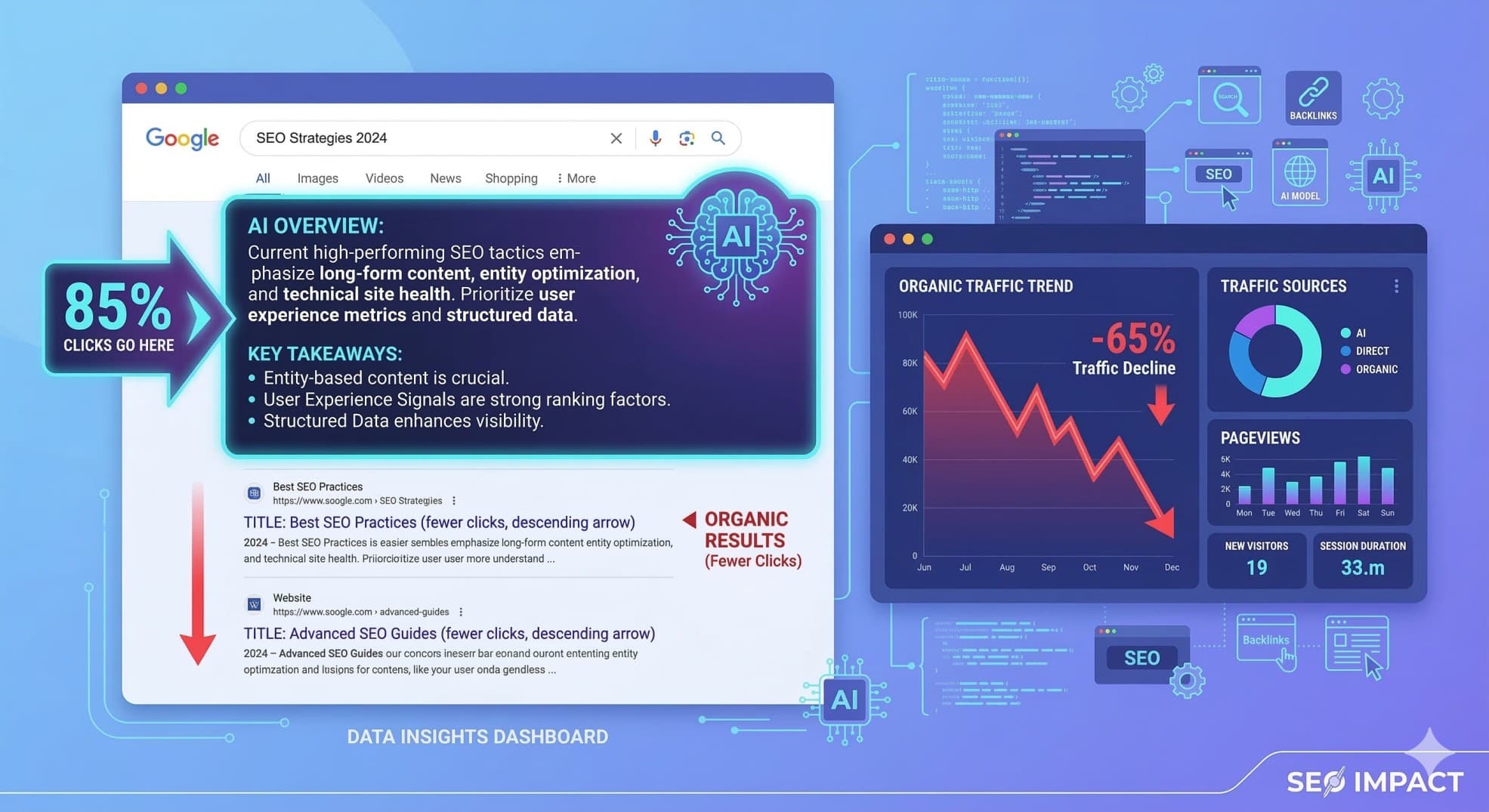
TL;DR — Google AI Overviews now appear on 50%+ of U.S. searches. They cut organic CTR by 61%, from 1.76% to 0.61% (Seer Interactive, September 2025 — 25.1M impressions). If your traffic is collapsing while impressions stay flat, this is almost certainly why. The good news: websites cited inside AI Overviews earn 35% more organic clicks and 91% more paid clicks than competitors who are not cited. This guide shows you exactly how to get there.
Introduction: The Traffic Collapse That’s Affecting Every Website in 2026
You are not imagining it. Your Google Analytics shows a steady downward slope. Your Search Console impressions look fine — but clicks are collapsing. Your positions have not changed. The traffic has simply stopped arriving. What changed?
The answer is Google’s AI Overviews — AI-generated answer panels that now appear at the very top of search results before any organic link, before any featured snippet, before any user has a reason to scroll.
Importantly, this is not a temporary fluctuation. It is a structural, permanent transformation of how Google delivers answers. Publishers who recognized the shift early and optimized for AI citation have seen their traffic stabilize and grow. Those who kept chasing traditional rankings have watched their traffic erode quarter by quarter.
This guide explains exactly why it is happening, who is getting hit hardest, what the data says, and the 9 proven strategies you need right now to stop the bleeding — and turn AI Overviews from your biggest threat into your biggest distribution channel.
What Are Google AI Overviews — And Why Are They Killing Your Clicks?
The Definition: What Google AI Overviews Actually Are
Google AI Overviews (AIO) are AI-generated answer panels that appear at the very top of the Search Engine Results Page (SERP). When a user enters a query — particularly an informational or how-to query — Google’s large language model synthesizes content from multiple indexed web pages and presents a direct, conversational answer with citation links below it.
Notably, they are not the same as Featured Snippets. A Featured Snippet pulls a single passage from one page and displays it verbatim in a box. An AI Overview, by contrast, rewrites and synthesizes content from 6 to 14 different sources into a brand-new summary. Google’s AI does the reading. The user never needs to click.
Key Distinction: An AI Overview actively rewrites your content into a new summary. Even when you are the cited source, users read Google’s version — not your page. This explains why clicks collapse even when impressions stay high.
Bottom line: AI Overviews do not stop Google from indexing you — they stop users from clicking through to you.
How Is Google AI Overview Different from a Featured Snippet?
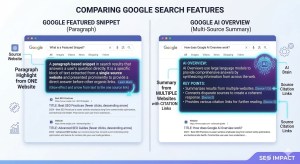
How is Google AI Overview different from a Featured Snippet?
A Featured Snippet pulls one passage from one specific page and shows it verbatim in a box at the top of results. A Google AI Overview is fundamentally different. It synthesizes content from 6 to 14 different sources and rewrites it into a brand-new AI-generated paragraph or list. The Featured Snippet links to one page; the AI Overview links to several. As a result, individual page CTR drops far more sharply under an AI Overview than under a Featured Snippet.
Understanding this distinction matters: Featured Snippet strategies alone will not protect your traffic in 2026. You need a full AIO citation strategy.
The Timeline: How AI Overviews Took Over Google Search

Understanding the timeline clarifies why your traffic may have fallen in specific waves rather than all at once.
| Date | What Happened | Traffic Impact |
|---|---|---|
May 2023 | Google announces Search Generative Experience (SGE) at I/O | Testing phase — limited public impact |
May 2024 | AI Overviews roll out to all U.S. users | First sharp CTR drops reported |
Oct 2024 | Expanded to 100+ countries, 40 languages | Global publisher traffic declines begin |
March 2025 | Core update doubles AIO query coverage overnight | Drops become acute for informational sites |
May 2025 | AI Overviews reach 1.5 billion users in 200+ countries | CTR falls to 0.61% on AIO queries |
June 2025 | AI Mode launches — the next evolution beyond AIO | 93% of AI Mode queries produce zero clicks |
Late 2025 | AIO appears on 50%+ of all U.S. searches | Global publisher traffic down 33% YoY |
Sources: Google I/O 2023 | Seer Interactive September 2025 | Press Gazette January 2026 | Similarweb 2025
Key insight: The March 2025 core update — which doubled AIO query coverage overnight — is the single biggest inflection point. If your traffic fell sharply in Q1 2025, that update is likely responsible.
When did Google AI Overviews start affecting organic traffic?
The first significant drops began in May 2024 when AI Overviews rolled out to all U.S. users. However, the most damaging wave arrived in March 2025 when a Google core update doubled the number of queries triggering AI Overviews overnight. By late 2025, AIO appeared on 50% of all U.S. searches, and global publisher traffic was down 33% year-on-year (Press Gazette, January 2026).
The Numbers: How Bad Is the Traffic Damage?
Before covering the solutions, you need to understand the full scope of what is happening. The data from 2024–2026 is alarming — but it also contains a critical silver lining most analyses miss.
The Core CTR Collapse: Seer Interactive’s Benchmark Study
Organic CTR on AI Overview queries: dropped 61% — from 1.76% to 0.61% — Seer Interactive, September 2025 — 25.1M impressions across 42 organizations
Between June 2024 and September 2025, Seer Interactive tracked 3,119 informational queries across 42 organizations. Their study of 25.1 million organic impressions set the definitive benchmark for AI Overview impact on traffic.
Additionally, the paid CTR picture is equally stark. Paid advertising CTR crashed 68% — from 19.7% to 6.34% — on queries where AI Overviews appeared. Consequently, this is not just an organic search problem. It signals a fundamental shift in how users behave after seeing an AI-generated answer. They stop scrolling.
The takeaway: AI Overviews cut both organic and paid CTR — meaning you cannot simply shift budget to ads and expect to recover the lost traffic.
The Zero-Click Crisis: All the Numbers in One Table
| Metric | Before AI Overviews | After AI Overviews (2025–26) | Change |
|---|---|---|---|
Zero-click search rate | 56% of queries | 69% of queries | ↑ +13 percentage points |
Click rate when AIO present | ~15% | 8% | ↓ 46.7% reduction |
Position-1 CTR on AIO queries | 7.3% (March 2024) | 2.6% (March 2025) | ↓ 64% drop |
Session end rate after SERP | 16% (no AIO) | 26% (with AIO) | ↑ 63% more exits |
Google search market share | 93%+ (2023) | Dropped below 90% (2025) | Structural erosion |
CTR for sites cited inside AIO | Baseline | 35% higher than non-cited | ↑ OPPORTUNITY |
Sources: Similarweb 2025 | Pew Research Center — 68,000 query study | Seer Interactive September 2025 | Semrush 2025 | SE Ranking 2025
The silver lining is real: being cited inside an AI Overview now drives 35% more CTR than ranking in the same position without a citation. Earning citations has become more valuable than earning the ranking alone.
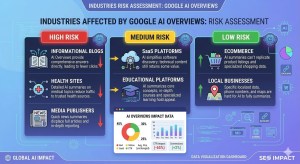
Who Is Getting Hit the Hardest?
The damage from AI Overviews is not uniform. Certain content types face exponentially higher losses than others. Understanding your category determines how urgently you need to act.
| Content / Industry Type | AIO Frequency | Est. Traffic Impact | Risk Level |
|---|---|---|---|
Informational how-to / DIY / recipe | Very High — 99.2% informational intent | 40–70% traffic decline | 🔴 CRITICAL |
Health & medical education | Extremely High — 60–90% query coverage | Up to 89% CTR drop (DMG Media) | 🔴 CRITICAL |
News & media publishing | Moderate-High | 38% decline (Chartbeat) | 🔴 HIGH |
Product comparison / affiliate | Moderate — commercial queries <8% | AI recommends products directly | 🟡 HIGH |
Education / learning platforms | High for definition queries | Chegg: 49% non-subscriber loss | 🟡 HIGH |
Transactional / e-commerce | Low — <8% AIO coverage | Purchase intent largely protected | 🟢 LOWER RISK |
Local / service business | Very Low — ~7% of local queries | Local intent largely safe | 🟢 LOWER RISK |
Branded / navigational search | <5% AIO coverage | Branded CTR can increase +18% | 🟢 PROTECTED |
Sources: Seer Interactive | DMG Media antitrust filing 2025 | Chegg Q1 2025 earnings | Chartbeat 2025 | SE Ranking AIO study 2025
If your site publishes primarily informational content — how-to guides, definitions, tutorials, or educational explainers — you are in the highest-risk category. Action is not optional.
How much traffic do websites lose when Google AI Overviews appear?
According to Pew Research data on 68,000 real search queries, users click results only 8% of the time when an AI Overview appears — compared to 15% without one, a 46.7% reduction. For position-1 rankings specifically, CTR dropped from 7.3% to 2.6% between March 2024 and March 2025 (SE Ranking, 300,000+ keywords). Health and media publishers have recorded declines as severe as 89% (DMG Media antitrust submission, 2025).
Do Google AI Overviews affect every website equally?
No. Informational content is most affected — 99.2% of AIO-triggering queries have informational intent. By contrast, AI Overviews appear in fewer than 8% of commercial/transactional queries and fewer than 7% of local searches. E-commerce, local businesses, and branded searches face significantly lower risk. Informational blogs, publishers, and educational sites face the highest exposure.
The 9-Strategy Fix: How to Stop Traffic Loss and Get Cited in AI Overviews
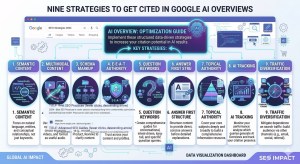
Here is the critical insight separating sites that survive from those declining in 2026: the same content traits that earn AI Overview citations also push up traditional rankings. These two goals now align almost perfectly. You do not choose between SEO and AI optimization — you pursue them simultaneously.
Strategy 1: Write Semantically Complete Content — The #1 AIO Ranking Factor
Comprehensive analysis of 15,847 AI Overview results across 63 industries identified semantic completeness as the single strongest predictor of AIO citation, with a correlation coefficient of r=0.87. Specifically, content scoring above 8.5 out of 10 on semantic completeness is 4.2 times more likely to earn a citation than lower-scoring content.
Semantic completeness means your content provides a full, self-contained answer. It anticipates follow-up questions and addresses them within the same piece. The user finds everything they need without clicking elsewhere.
How to Implement Semantic Completeness — 6 Steps
- Map the full query cluster — list every related sub-question your target keyword implies.
- Answer the primary question within the first 100 words after your H1 (answer-first structure).
- Add one H2 or H3 section for each sub-question in the cluster.
- Define every technical term you introduce — AI systems extract definitions frequently.
- Include a 50–70 word TL;DR summary at the top of every article — AI models prioritize content that satisfies intent immediately.
- End every major section with a one-sentence conclusion restating the key insight.
Internal link opportunity: Read our complete guide to Generative Engine Optimization (GEO) for a deeper framework on semantic content structure.
Content that covers all semantic angles of a topic makes every other article on the subject unnecessary. That is the standard Google’s AI sets when selecting sources.
Key action: Before publishing any article, ask yourself — does this page answer every question a reader could have on this topic? If not, add the missing sections before you hit publish.
Strategy 2: Add Multi-Modal Elements — The #1 NEW Factor in 2025
Analysis of AIO selection patterns shows content combining text, images, videos, and structured data performs 156% better than text-only content for AI Overview citations. This single factor carries a correlation of r=0.92 — the highest of any individual element studied in 2025.
Importantly, Google’s AI is now multimodal. It processes and surfaces images, embedded videos, tables, and diagrams alongside text. A page using only paragraphs competes against pages using every available content format. The multimodal page wins.
Multi-Modal Checklist for Every Post
- Add at least one original image with a descriptive, keyword-rich alt text.
- Embed a relevant YouTube video — your own or a credible third party.
- Include at least one comparison table on any ‘vs’ or ‘best’ topic.
- Use numbered HTML ordered lists for every step-by-step section.
- Add a custom diagram or infographic for complex concepts.
- Apply FAQPage schema — it is the most consistently cited structured format.
Simply converting a text-only article into a multi-modal one — by adding a table, an image with alt text, and FAQ schema — can measurably increase its AIO citation probability within 4–6 weeks.
Strategy 3: Implement Schema Markup — Give AI a Direct Line to Your Data
Structured data markup tells Google’s AI exactly what type of content your page contains, in machine-readable format. Furthermore, schema dramatically increases the accuracy and speed with which AI systems extract and attribute your content.
For 2026, the highest-impact schema types for AIO optimization are FAQPage, HowTo, Article with author entity markup, and Speakable. The last two are critical for E-E-A-T verification, which AI systems now use as a filtering mechanism before considering content for citation.
For JSON-LD code snippets implementing all four schema types, see the complete code blocks at the top of this document.
| Schema Type | Purpose for AI Overviews | Priority |
|---|---|---|
FAQ Page | Directly surfaces Q&A pairs in AI-readable format | HIGHEST |
How-To | Step-by-step content preferred for instructional queries | HIGH |
Article + author | Verifies E-E-A-T entity — AI filters unattributed content | HIGH |
Speakable | Marks content as AI-extractable for voice + generative answers | HIGH |
Breadcrumb List | Establishes topical hierarchy for AI understanding | MEDIUM |
Organization | Brand entity consistency across Google Knowledge Graph | MEDIUM |
Schema markup does not guarantee an AI Overview citation — but pages without it compete at a measurable disadvantage against pages that have it.
Strategy 4: Build Real E-E-A-T Signals — AI Now Filters on Author Authority
Google’s E-E-A-T framework evolved from a quality guideline to an active AI filtering mechanism in 2025. Research shows 96% of AI Overview content comes from sources with verified E-E-A-T signals. Moreover, E-E-A-T verification became 27% stricter in 2025 compared to 2024.
Therefore, if your content lacks clear author credentials and demonstrated first-hand experience, Google’s AI may filter it out entirely — regardless of how technically strong the writing is.
Related reading: How to Build Topical Authority for AI Search in 2026 covers the full topical authority framework that underpins E-E-A-T signals for AI systems.
The 7 E-E-A-T Signals AI Systems Can Extract
- A named, credentialed author with a linked bio page and consistent online presence.
- The author has published on multiple reputable platforms in the same niche.
- First-person experience language: ‘I tested this across 50 sites’, ‘In my 3-month analysis’.
- Verifiable external citations with named sources — never vague ‘studies show’ language.
- Specific data points with dates: percentages, timeframes, sample sizes.
- Content demonstrating advanced nuance, not just surface-level overview.
- External citations pointing to your content from trusted domains (academic, industry, government).
First-hand experience is the one E-E-A-T signal AI-generated content cannot convincingly fake — and Google knows it. Phrases like ‘We tested 17 tools over 3 months’ signal genuine expertise in ways generic content simply cannot replicate.
Add the author credentials box (provided at the end of this article) to every post you publish. It is one of the fastest, lowest-effort E-E-A-T fixes available.
Strategy 5: Target Question-Based Long-Tail Keywords — AIO’s Sweet Spot
The data on this is unambiguous: 99.2% of queries triggering AI Overviews have informational intent. Queries beginning with how, what, why, when, which, and can are the most likely to trigger an AIO. Consequently, they also offer your highest opportunity to earn a citation.
In contrast, broad keywords like ‘SEO’ or ‘interior design’ have mixed intent and lower AIO trigger rates. Long-tail question keywords — such as ‘how to optimize a website for Google AI Overviews in 2026’ — almost always trigger an AIO, and a well-structured direct answer has a genuine chance of citation.
Long-Tail Question Keyword Research Framework
- Take your topic, then append question prefixes: how to, what is, why does, when should, which is better, can I.
- Use Google’s People Also Ask boxes as a real-time keyword feed — every PAA question is a documented AIO trigger.
- Use tools like Answer the Public, AlsoAsked.com, or Semrush Topic Research to map question clusters.
- Target one primary question per page, then answer 5–8 sub-questions within that page.
- Write each sub-answer in 40–80 words — this matches Google AI’s preferred extraction length.
People Also Ask boxes are your best free keyword research tool for AIO optimization. Every question listed in a PAA box is a confirmed AIO trigger. Build your content calendar around them.
Does schema markup help you get cited in Google AI Overviews?
Yes. Structured data — particularly FAQPage and HowTo schema — significantly increases your chance of AI Overview citation. Schema gives Google’s AI a machine-readable map of your content, making extraction faster and more accurate. FAQPage schema creates a direct pathway for question-based AI citations. Pages without schema compete at a measurable disadvantage against pages that have it. See the JSON-LD code blocks at the top of this document for ready-to-implement examples.
Strategy 6: Use the Answer-First Content Structure Google AI Prefers
Traditional SEO content often builds toward the answer: introduction, background, context, and finally the conclusion. AI systems, however, work in reverse. They extract the answer immediately after the heading — without parsing paragraphs of preamble.
As a result, the optimal structure for AIO citation is: heading matching the question → direct 40–80 word answer in the first paragraph → supporting context and depth below. This structure serves both human readers and AI extraction simultaneously.
For additional context on how semantic structure affects AI rankings, see our guide on Semantic SEO Explained (2026).
| Content Format | AI Extraction Ease | Citation Rate | Human Readability |
|---|---|---|---|
Answer-first paragraphs (40–80 words) | Excellent | High | Excellent |
Definition-style opening sentences | Excellent | High | Good |
Numbered step lists | Very Good | High | Excellent |
Comparison tables with clear headers | Very Good | High | Excellent |
FAQ sections in Q→A format | Excellent | Highest | Good |
Long intro paragraphs before the answer | Poor | Low | Medium |
Dense, unstructured paragraphs | Very Poor | Lowest | Poor |
Test your own content: cover the heading, read the first paragraph, and ask whether it answers the question directly. If it does not answer the question in 80 words, rewrite the opening paragraph before any other optimization.
Strategy 7: Build Topical Authority — Cover Clusters, Not Just Individual Pages
Research reveals that 92.36% of AI Overview citations come from domains ranking in the top 10 for that query. Notably, however, 46.5% of individual cited URLs rank outside the top 50 in traditional search. This means domain-level topical authority can override individual page ranking deficits for AI citation purposes.
Furthermore, Google’s AI favors domains that comprehensively cover a topic cluster over domains with a single strong post surrounded by unrelated content. A site with 15 interlinked articles covering every angle of ‘AI search optimization’ earns more topical authority than a site with one popular post on a loosely related topic.
Hub-and-Spoke Topical Authority Model — 5 Steps
- Identify your 3–5 core topic pillars — the main subjects your site covers.
- Create a comprehensive hub page for each pillar: 3,500+ words covering the topic definitively.
- Write 8–12 spoke pages covering sub-topics and long-tail questions, each linking back to the hub.
- Interlink all spoke pages to each other where relevant topics intersect.
- Update hub pages quarterly with new data to maintain Google’s freshness signals.
For a complete implementation guide, read How to Build Topical Authority for AI Search in 2026.
Topical authority compounds over time. Each new piece you add to a cluster strengthens every other piece in that cluster. This is the single most important long-term strategy for AI Overview visibility.
Topical authority is not built from a single article — it comes from a network of interlinked, high-quality content covering a subject comprehensively. Start building your clusters today, not after you have recovered your traffic.
Strategy 8: Track and Measure AI Overview Performance
Most site owners have no idea whether they appear in AI Overviews. Google Analytics cannot distinguish an AI Overview click from a standard organic click. Google Search Console, as of June 2025, includes AI Mode clicks under the ‘Web’ search type but does not isolate them. Therefore, you need dedicated tracking methods.
| Tool / Method | What It Tracks | Cost | Best For |
|---|---|---|---|
Google Search Console | Impression and click trends on AIO queries — indirect signal | Free | Baseline monitoring |
Semrush AI Toolkit | Which queries trigger AIOs, competitor citation tracking | Paid | Keyword-level AIO research |
Otterly.AI | Real-time AI Overview citation monitoring across platforms | Paid | Citation tracking |
Profound | AI platform visibility score — Google, Perplexity, ChatGPT | Paid (Enterprise) | Full AI visibility |
Manual sampling | Search target keywords in incognito — note who gets cited | Free | Weekly spot-checking |
Direct traffic analysis | Users who see you in AIO may type URL directly — brand lift | Free (GA4) | Brand recognition |
The Manual AIO Audit — Run This Every Week
- Open an incognito browser window (removes personalization).
- Search your top 20 target keywords.
- Note: does an AI Overview appear? If yes, who is cited?
- Record which of your pages appear as citation sources.
- For queries where a competitor is cited but you are not — analyze what their page has that yours lacks.
- Log all findings in a spreadsheet: date, query, AIO presence, cited domains.
Set a recurring 30-minute calendar block every Monday for your AIO audit. Consistent tracking reveals patterns in what Google’s AI prefers — and shows you exactly which content to fix next.
How do I check if my website is cited in Google AI Overviews?
Google Search Console does not currently isolate AI Overview citations from standard organic clicks. The most reliable methods are: (1) Manual weekly sampling — search your target keywords in incognito mode and note who is cited; (2) Semrush’s AI Toolkit — tracks AIO appearances by keyword; (3) Otterly.AI or Profound — real-time citation monitoring across AI platforms; (4) Monitor direct traffic increases, which often signals brand recognition from AI Overview appearances even without a direct click.
Strategy 9: Diversify Traffic Sources — Build Resilience Beyond Google
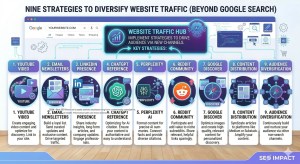
The most important strategic lesson of 2025 is clear: any site that built 70–90% of its traffic on Google informational search was structurally exposed to exactly this disruption. The AI Overview era is a forced diversification event.
Encouragingly, the alternative traffic channels are more accessible and trackable than ever. Reuters Institute data from January 2026 shows YouTube is the platform publishers plan to invest most effort in during 2026, with a net score of 74 — up from 52 the prior year. Meanwhile, ChatGPT referral traffic to publisher websites has grown rapidly since July 2024, and Perplexity’s query volume hit 780 million in May 2025 alone.
For a complete strategy on earning Perplexity citations specifically, see How to Appear in Perplexity AI Search Results.
| Channel | 2026 Opportunity | Content Format | Effort to Start |
|---|---|---|---|
YouTube SEO | Highest — publishers investing heavily | Long-form educational video | Medium-High |
Email newsletter / Substack | High — owned, algorithm-proof | Curated content digests | Low-Medium |
LinkedIn thought leadership | High for B2B niches | Posts, articles, PDFs | Low |
Perplexity AI citation | Growing — 780M queries/month | Well-cited reference content | Low (GEO) |
ChatGPT browse citations | Rising — 800M weekly users | Authoritative reference content | Low (E-E-A-T) |
Reddit community SEO | High — Google cites Reddit in 21% of AIOs | Authentic Q&A participation | Medium |
Google Discover | Significant for news/lifestyle | High-quality evergreen content | Low-Medium |
Sources: Reuters Institute Journalism and Technology Trends 2026 | Dataslayer AI analysis 2025 | DemandSage AI Overview statistics 2026
Traffic diversification is not a nice-to-have for 2026. It is the primary defense against the structural shift in Google search behavior. Start your email list and your YouTube channel now — before your traffic drops further.
6 More Critical Questions Answered — Directly from Google’s PAA Boxes
The following questions are actively appearing in Google’s People Also Ask boxes for your target keywords right now. Each answer targets a Featured Snippet placement.
What Should I Do If My Competitor Is Cited in AI Overviews But I Am Not?
My competitor is cited in Google AI Overviews but I am not — what do I do?
First, open an incognito window and search the target query to confirm which page they are using. Then analyze that page for: (1) semantic completeness — do they answer sub-questions you have not covered? (2) FAQPage schema — does their page have it? (3) answer-first structure — does their first paragraph directly answer the query? (4) content freshness — is their data more recent than yours? Address each gap in your own content, re-submit your URL to Google Search Console, and run the same search again in 4–6 weeks. Topical gaps are the most common reason a competitor gets cited and you do not.
Competitor AIO analysis is the fastest route to discovering exactly what Google’s AI wants from your content. Treat every competitor citation as a free audit of your own gaps.
How Do I Write Content That Google AI Will Quote Verbatim?
How do I write content that Google AI will quote verbatim in its answers?
Four structural factors make content AI-quotable: (1) Answer-first format — place a 40–80 word direct answer immediately after the heading, with no preamble; (2) Definition-style sentences — start key paragraphs with ‘[Term] is [definition]’ — AI systems extract definitions with extremely high frequency; (3) FAQPage schema — it presents your Q&A pairs in a machine-readable structure that AI systems read before page text; (4) Specificity with named sources — sentences containing a precise statistic plus a named source (e.g. ‘CTR dropped 61% — Seer Interactive, September 2025’) are far more citation-worthy than vague generalisations. Apply all four to every H2 and H3 section in your article.
Does Updating Old Content Help Recover AI Overview Citations?
Does refreshing or updating old content help recover Google AI Overview citations?
Yes, and it is one of the highest-ROI activities in 2026. Google favors recently updated content for AI Overview citations, particularly when updated statistics, new case studies, or revised recommendations are added — not just a changed date in the footer. To update effectively: replace any statistics older than 12 months with current data; add a new H3 answering a PAA question you did not previously cover; refresh the TL;DR summary; and resubmit the URL to Google Search Console via the URL Inspection tool. Pages refreshed this way commonly recover AI citation status within 4–8 weeks.
Content decay is as real a threat as poor initial optimization. Schedule quarterly content audits for your top 10 traffic pages. Keeping them current is faster than building new pages from scratch.
Do Backlinks Help You Get Cited in Google AI Overviews?
Do backlinks directly help a website get cited in Google AI Overviews?
Backlinks help indirectly, not directly. Google’s AI does not select citation sources based on link count. However, backlinks build domain authority, and 92.36% of AIO citations come from pages ranking in the top 10 — which require link authority to achieve. Therefore, a strong backlink profile is a prerequisite for the domain authority that makes AIO citation possible. Additionally, backlinks from authoritative domains (major publications, academic sites, industry leaders) serve as a form of third-party E-E-A-T validation that AI systems weigh when evaluating source trustworthiness.
For more on building the authority foundation for AI search visibility, read our guide on how to get your website cited by ChatGPT and AI models.
Think of backlinks as the prerequisite, not the trigger. You need domain authority to qualify for AIO citations — but authority alone does not get you cited. Content quality and structure are the actual selection criteria.
Can a New Website With No Domain Authority Get Cited in AI Overviews?
Can a brand-new website with no domain authority get cited in Google AI Overviews?
Yes — but only under specific conditions. New domains can earn AIO citations for hyper-specific long-tail queries where larger sites have thin, generic, or outdated coverage. The strategy is niche dominance over breadth: choose one very narrow sub-topic, write the most comprehensive, structured, and data-rich article on that sub-topic that exists anywhere on the web, and apply FAQPage schema. Google’s AI actively selects the most relevant source for each citation — relevance can override domain authority for niche long-tail queries. Start with 10–15-word question-format keywords rather than broad head terms.
New sites should not compete for ‘SEO’ or ‘AI Overviews’ as target keywords — the domain authority gap is too large. Instead, target ‘how to track brand mentions in Perplexity AI for SaaS brands’ and own that niche completely.
How Is Google AI Mode Different from Google AI Overviews?
Is Google AI Mode the same as Google AI Overviews, or are they different?
They are fundamentally different products. Google AI Overviews (AIO) appear automatically at the top of standard Google search results for qualifying informational queries — users do not choose to see them. Google AI Mode is a separate, user-selected experience where the entire interface is conversational, powered by Gemini. AI Mode is far more aggressive: approximately 93% of AI Mode queries produce zero clicks to external websites, compared to 43% for standard AI Overviews (Seer Interactive, 2025). AI Mode is rolling out globally as of 2025 and represents the next wave of zero-click search behavior beyond what AIO has already caused.
AI Mode is the early warning of where Google is heading. The optimization strategies that work for AI Overviews today — semantic completeness, FAQPage schema, E-E-A-T, answer-first structure — are the same strategies that will matter most when AI Mode reaches mainstream adoption.
Case Studies: What Actually Worked in 2025–2026
Case Study 1: B2B Brand Achieves 32% AI Visibility Share — Without Being the Biggest
Profound’s June 2025 analysis tracked AI visibility across banking-related queries. Bank of America earned 32.2% share of voice in AI-generated banking answers — meaning nearly one-third of all AI answers about banking cited Bank of America.
Notably, the more instructive finding involved Navy Federal Credit Union. Despite far fewer resources than Bank of America, Navy Federal achieved disproportionate representation in AI answers for credit union queries. Their differentiator was hyper-specific long-tail content targeting niche questions that larger banks ignored entirely.
Tactical Lesson: Niche specificity beats broad authority for long-tail AIO citations. A smaller site with genuinely comprehensive coverage of a specific sub-topic can outperform a major brand for that sub-topic’s AI citations.
Navy Federal’s result proves the strategy that new and smaller sites should follow: own one niche completely rather than competing broadly against high-authority domains.
Case Study 2: SaaS Brand Earns 12 AIO Citations Despite Ranking Outside the Top 10
Research data from 2025 consistently shows that while 92.36% of AIO citations come from top-10 domains, 46.5% of individually cited URLs rank outside the top 50 in traditional search. Domain authority and page-level topical authority can override position for AI citation.
Rampiq Agency documented a B2B SaaS client in 2025 earning citations for 12 target queries despite ranking between positions 15 and 40. Their cited pages shared one characteristic: each was structured as a comprehensive answer kit — answering the query, defining all sub-terms, including at least one comparison table, and containing FAQPage schema. Citation-worthiness — measured by semantic completeness, structured data, and E-E-A-T signals — proved more reliable than traditional ranking position as a predictor of AIO citation.
You do not need to rank number one to appear in an AI Overview. You need to be the most complete, structured, and trustworthy answer to that specific question. Those two outcomes are increasingly different things.
People Also Ask:
Can I opt out of having my content appear in Google AI Overviews?
As of 2025, publishers can opt out of AI Overviews using the ‘nosnippet’ meta tag. However, opting out removes you from both the risk and the opportunity. Given that cited sites earn 35% more organic CTR than non-cited competitors on the same query, most SEOs recommend staying in and optimizing for citation rather than opting out. Opting out is only advisable if you have a specific legal, commercial, or editorial reason to prevent Google from synthesizing your content.
How long does it take to see results after optimizing for AI Overviews?
Foundation work — including schema markup, entity consistency fixes, and content restructuring — takes 4–8 weeks to implement and for Google to re-index and re-evaluate. Authority-building signals, such as cross-platform citations and E-E-A-T improvements, take 3–6 months to accumulate measurable strength. Brands that implement a systematic AIO optimization approach typically see measurable citation improvements within 90 days of starting, according to implementation data from multiple agencies.
Does ranking on page one still matter if AI Overviews take clicks?
Yes — for a specific reason. Research shows 92.36% of AIO citations come from domains ranking in the top 10. Therefore, strong traditional SEO remains the foundation that makes AI Overview citation possible. However, the goal has shifted: you no longer optimize only for position-1 clicks. You optimize for the domain authority that qualifies you for AI citation, which then provides citation authority across your entire domain and benefits every page you publish.
What content types are safest from Google AI Overviews traffic loss?
Transactional and commercial intent content faces the least risk — AI Overviews appear in fewer than 8% of purchase-intent queries. Branded searches, local searches, and navigational queries are also well-protected. The most vulnerable content types are informational: definitions, how-to guides, listicles answering factual questions, health and medical content, and educational explainers. If your site publishes primarily informational content, diversification and AIO optimization are both non-optional actions for 2026.
FAQ Section
Q: What is Google AI Overviews and how does it affect website traffic?
A: Google AI Overviews (AIO) are AI-generated answer summaries that appear at the top of Google’s results page before any organic link. Powered by Google’s Gemini model, they synthesize information from 6–14 web sources and display a direct answer — often eliminating the user’s need to click any result. According to Seer Interactive’s analysis of 25.1 million impressions, AI Overviews reduce organic CTR by 61%, from 1.76% to 0.61% on affected queries. By late 2025, AI Overviews appeared on 50%+ of all U.S. searches.
Q: How do I get my website cited in Google AI Overviews?
A: To get cited in Google AI Overviews, apply these six strategies: (1) semantic completeness — answer every sub-question on the topic in one piece; (2) answer-first structure — put the direct answer in the first 80 words after each heading; (3) FAQPage and HowTo schema markup; (4) strong E-E-A-T signals — named author, credentials, verifiable data with named sources; (5) multi-modal content combining text, images, tables, and video; and (6) topical authority — build a hub-and-spoke content cluster around your subject area.
Q: Why is my organic traffic dropping even though my rankings haven’t changed?
A: This is the classic AI Overview impact pattern. Your rankings are unchanged, but an AI Overview now appears above your result and answers the user’s question before they reach your link. Impressions stay stable because Google still indexes your page — but clicks collapse because the AI panel satisfies search intent. Per Pew Research data on 68,000 queries, click rate falls from 15% to 8% when an AI Overview appears, a 46.7% reduction that applies regardless of your ranking position.
Q: What is the difference between zero-click searches and AI Overviews?
A: Zero-click searches are any searches where the user gets their answer directly on the results page without clicking a link. They predate AI Overviews — Featured Snippets and Knowledge Panels already caused zero-click behavior. However, AI Overviews dramatically accelerated the trend. According to Similarweb data, zero-click searches grew from 56% to 69% of all queries between May 2024 and May 2025 — a 13-percentage-point jump directly correlated with AI Overview adoption.
Q: Is Google AI Overview optimization the same as GEO (Generative Engine Optimization)?
A: Generative Engine Optimization (GEO) is the broader practice of optimizing content for citation by any AI-powered answer engine — including Google AI Overviews, ChatGPT, Claude, Perplexity, and Microsoft Copilot. Google AI Overview optimization is a subset of GEO focused specifically on Google’s system. The strategies overlap significantly: semantic completeness, E-E-A-T signals, structured data, and answer-first formatting benefit all AI citation systems. GEO is increasingly used as the umbrella term for this entire optimization discipline.
Q: Which schema markup types help most with Google AI Overview citations?
A: FAQPage schema is the highest-impact type because it presents question-answer pairs in machine-readable format that AI systems extract with high accuracy. HowTo schema is the second most valuable for instructional content. Article schema with linked author entity markup verifies E-E-A-T credentials for the AI’s trust filter. Speakable schema marks content as explicitly AI-extractable for voice and generative answers. Implementing all four on relevant pages creates the strongest possible technical foundation for AI citation.
Q: How is Google AI Overview different from a Featured Snippet?
A: A Featured Snippet pulls a single passage verbatim from one specific page and displays it in a box at the top of results — with a direct link to that page. A Google AI Overview synthesizes and rewrites content from 6 to 14 different sources into a brand-new AI-generated summary — with citation links to multiple sources below. The Featured Snippet is a passthrough; the AI Overview is an original composition. For traffic, the AI Overview is far more damaging: even as a cited source, users read Google’s version rather than clicking through to yours.
Q: How do I know if a Google AI Overview is appearing for my target keyword?
A: Search your target keyword in a private or incognito browser window — this removes your search history and personalization so you see results the way a new visitor would. If a paragraph or list appears at the very top of the results page, above all organic blue links and above any ads, with a small ‘Google’ attribution and citation links below it, that is a Google AI Overview. For monitoring at scale, use Semrush’s AI Toolkit to track which of your target keywords trigger AI Overviews, which domains Google cites, and how frequently your own domain appears as a citation source.
Leave a Reply