
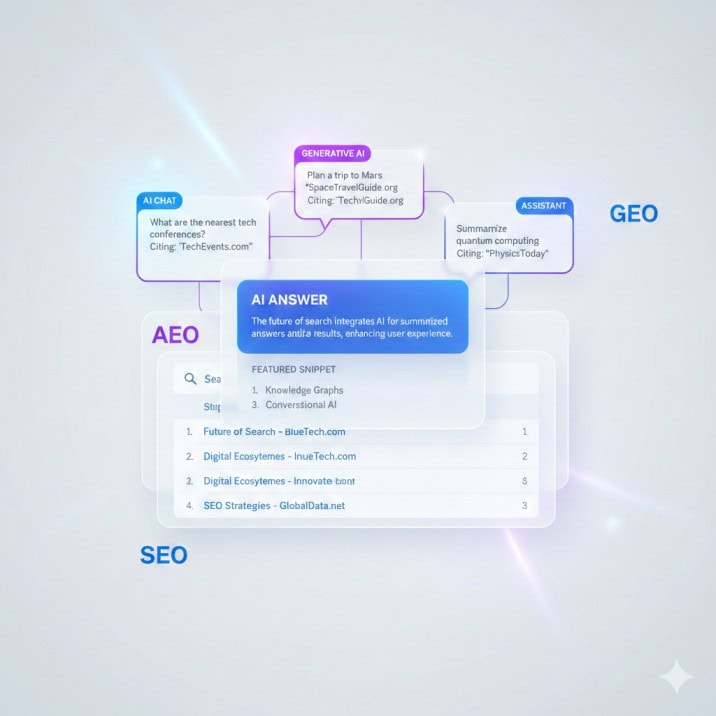
In 30 seconds: SEO gets you ranked on Google. AEO gets you quoted as the direct answer. GEO gets you cited by ChatGPT, Gemini, and Perplexity. All three matter in 2025 — but they work differently, measure differently, and require different content strategies. This guide explains every key distinction in plain English.
Why Search Optimization Is No Longer One Thing
For two decades, “search optimization” meant one thing: rank higher on Google. You targeted keywords, built backlinks, and improved your website’s technical performance. That was the whole game.
That game has fundamentally changed.
Today, 60% of Google searches in the US end without a single click — users get their answer directly on the results page, according to SparkToro’s 2024 zero-click search analysis. Meanwhile, AI referrals to websites surged 357% year-over-year between June 2024 and June 2025, per Jasper’s 2025 AI search report — a shift we break down in detail in our AI search optimization guide. And Gartner has projected that traditional search volume will drop 25% by 2026 as users migrate to AI assistants.
The result is a new three-layer search ecosystem. Understanding the AEO vs SEO vs GEO differences is no longer optional for marketers, content creators, or business owners. It is the minimum requirement for staying visible in the places where your audience searches.
This guide breaks down each discipline — what it is, how it works, what it measures, and how to use all three together in a unified strategy.
What Are SEO, AEO, and GEO? Clear Definitions
What Is SEO (Search Engine Optimization)?
SEO is the foundation of digital discoverability. It encompasses three core areas:
- On-page SEO: Keyword placement, heading structure, content depth, internal linking, and meta tags.
- Off-page SEO optimization: Building backlinks, brand mentions, and authority signals from external websites.
- Technical SEO: Site speed, crawlability, mobile optimization, schema markup, and Core Web Vitals.
SEO in digital marketing operates on a simple principle: rank higher, get more organic traffic. According to Statista, Google processes over 5.9 million searches per minute, making seo optimisation for websites a foundational business activity — not a nice-to-have.
Traditional SEO results typically require 3–6 months of consistent effort before meaningful ranking improvements appear. The success metric is keyword ranking and organic click-through traffic.
What Is AEO (Answer Engine Optimization)?
AEO targets Position Zero — the featured answer box that appears above all ranked results. It also optimizes for voice search responses, where Google or Siri reads a single answer aloud rather than presenting a list of links.
The rise of AEO is driven by one undeniable behavioral shift: users want answers, not links. Bain & Company research found that 80% of consumers rely on zero-click AI summaries at least 40% of the time. An AI Overview appearing in search results correlates with a 34.5% lower average CTR for the top-ranking organic page below it, according to Yext’s 2025 AEO analysis — because users got their answer without scrolling.
This sounds threatening, but there is an upside hidden in the data. Sources cited by answer engines experience a 27% higher click-through rate compared to traditional search placements when users do click, according to TNGShopper’s 2025 SEO statistics analysis. Being the answer builds authority faster than being a ranked result.
AEO results typically become visible within 1–3 months of structured implementation.

What Is GEO (Generative Engine Optimization)?
GEO was formally defined and studied by researchers Pranjal Aggarwal, Vishvak Murahari, and colleagues from Princeton University, Georgia Tech, the Allen Institute for AI, and IIT Delhi. Their landmark paper, “GEO: Generative Engine Optimization,” was published at the ACM SIGKDD 2024 conference (one of the world’s premier data science conferences) and established the first empirical framework for measuring and improving AI citation visibility.
To understand exactly which content signals make AI models choose one source over another, see our deep-dive guide on how to get your website cited by ChatGPT and other AI models.
Their findings are striking: adding citations, statistics, and authoritative sourcing to content boosts visibility in generative engine responses by up to 40%. (Aggarwal et al., KDD 2024, Princeton University — arxiv.org/abs/2311.09735)
Unlike SEO (which measures keyword rankings) and AEO (which measures snippet wins), GEO is measured by an emerging metric called Share of Model (SoM) — how frequently your brand or content is cited across AI-generated responses in your topic area. Initial GEO visibility can appear within 4–6 weeks; sustained citation authority builds over 3–6 months.
AEO vs SEO vs GEO: Side-by-Side Comparison
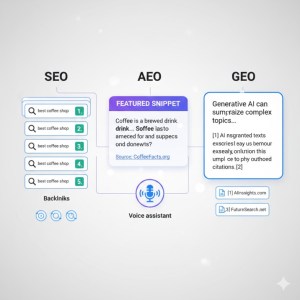
The table below captures the core AEO vs SEO vs GEO differences across every dimension that matters for practitioners.
| Dimension | SEO | AEO | GEO |
|---|---|---|---|
| Full Name | Search Engine Optimization | Answer Engine Optimization | Generative Engine Optimization |
| Primary Goal | Rank in Google / Bing SERPs | Be the direct answer (Position Zero) | Be cited in AI-generated responses |
| Target Platforms | Google, Bing, Yahoo | Google AI Overviews, Siri, Alexa, Cortana, Voice Search | ChatGPT, Gemini, Perplexity, Claude, Bing AI |
| Output Type | Ranked list of links | Featured snippet / spoken answer | AI-synthesized paragraph with citations |
| User Behavior | Browsing / clicking links | Asking specific questions | Conversational AI queries |
| Primary Metric | Keyword rankings, organic traffic | Snippet wins, zero-click impressions | Share of Model (SoM), citation frequency |
| Time to Results | 3–6 months | 1–3 months | 4–6 weeks (initial); 3–6 months (sustained) |
| Key Content Signals | Keywords, backlinks, page authority, Core Web Vitals | FAQ schema, concise answers, structured headings | Statistics, citations, entity authority, fact density |
| Technical Requirements | robots.txt, sitemap, canonical tags, page speed | Schema markup (FAQPage, HowTo, Speakable) | Allow AI bots (GPTBot, ClaudeBot), consider llms.txt |
| Zero-Click Risk | Medium (CTR declining) | High (answer replaces the click) | Medium (citation may drive brand recall > direct click) |
| Foundational Research | Google’s Search Quality Rater Guidelines (2024) | Google AI Overviews documentation (2024) | Aggarwal et al., Princeton / ACM SIGKDD 2024 |
How SEO, AEO, and GEO Each Work (Step by Step)
How Traditional SEO Works
Search engine optimisation in digital marketing has been refined over 25+ years. Google’s algorithm considers hundreds of ranking factors, but the core mechanics remain consistent: relevance + authority + user experience.
- Crawling: Googlebot discovers your page via links or your XML sitemap.
- Indexing: Google stores and analyzes your page’s content, structure, and signals.
- Ranking: Google compares your page against competitors on query-specific relevance, domain authority (off-page signals), E-E-A-T, and technical performance.
- SERP Appearance: Your page appears in ranked position with a title, URL, and meta description.
Key seo recommendations for a website include ensuring clear title tags, fast page load times (Core Web Vitals), mobile-first design, clean URL structure, internal linking, and consistent keyword usage — without stuffing.
For app seo optimization specifically (also called App Store Optimization or ASO), the mechanics shift to the app store algorithm: app title keywords, description, ratings, reviews, and download velocity are the dominant signals rather than backlinks.
How AEO Works
AEO operates on a different principle than SEO. Instead of asking “how do I rank first?”, AEO asks “how do I become the answer?”
- Query Intent Mapping: Identify the specific questions your audience asks (using People Also Ask data, keyword tools, and voice query analysis).
- Direct Answer Paragraphs: Open each H2 or H3 section with a 40–60 word direct answer to the question in the heading. Google’s AI Overviews and featured snippet algorithms extract these passages.
- Schema Markup: Implement FAQPage, HowTo, and Speakable schema so search engines can structurally identify answer content on your page.
- Conversational Language: Write in natural, question-answering language that mirrors how people speak to voice assistants — not just how they type into search bars.
- Position Zero Targeting: Format answers as self-contained paragraphs (for snippets), numbered lists (for “how-to” queries), or tables (for comparison queries).
A practical example: A pediatric dentist that publishes a FAQ page answering “What’s the best age for a child’s first dental visit?” with a clear 50-word answer and FAQPage schema will often have Google Assistant read that answer aloud to voice searchers — without requiring a click. (Yext, SEO vs AEO vs GEO Guide, 2025)
AEO principles apply just as powerfully outside Google. For a platform-specific breakdown, read our guide on how to appear in Perplexity AI search results, which covers every technical and content factor that earns citations on that platform.
How GEO Works
GEO is the most technically sophisticated of the three disciplines. Understanding it requires understanding Retrieval-Augmented Generation (RAG) — the two-stage process most AI search systems use. If you haven’t already, our website AI optimization guide explains exactly how AI systems retrieve, evaluate, and synthesize web content into answers.
- Stage 1 — Retrieval: The AI system searches for potentially relevant web documents using a search or crawl layer (similar to a traditional search engine).
- Stage 2 — Synthesis: A large language model reads the retrieved documents, evaluates each source for relevance, authority, and factual accuracy, then synthesizes a natural-language response — citing the sources it drew from most heavily.
Your content must succeed at both stages to earn a citation. It must be retrievable (technically crawlable) and citable (trustworthy and fact-dense enough that the LLM chooses to reference it).
According to the Princeton GEO study, the top-performing optimization methods are: adding verifiable statistics, incorporating citations to credible external sources, and using quotations from recognized authorities. These three methods together produced a 30–40% relative improvement in AI citation visibility. (Aggarwal et al., KDD 2024 — ACM Digital Library)
One critical and often-missed GEO technical factor: many websites unknowingly block AI crawlers. Cloudflare, which serves over 20% of all websites, changed its default configuration in 2025 to automatically block AI bots. To ensure GEO accessibility, explicitly allow GPTBot (OpenAI), ClaudeBot (Anthropic), and PerplexityBot in your robots.txt file. (The Jonas Agency, GEO Best Practices 2026)
People Also Ask: Common Questions About SEO, AEO, and GEO
Is SEO dead in 2025 because of AI?
No. Traditional SEO generated 1,000% more traffic than organic social media in 2024, according to BrightEdge’s organic search traffic study. More importantly, Semrush’s 2025 AI Search Report found that 99% of URLs appearing in Google’s AI Mode also rank in the top 20 organic results. This makes SEO a prerequisite for GEO success — not a competing strategy. AI systems can only cite what they can crawl and trust.
What is the difference between AEO and GEO?
AEO and GEO both optimize for AI-driven environments but target different systems. AEO focuses on extraction — getting your content pulled as a direct answer by Google’s AI Overviews, featured snippets, or voice assistants. GEO focuses on citation — getting your brand referenced inside responses generated by standalone AI platforms like ChatGPT, Claude, and Perplexity. AEO lives within the Google ecosystem. GEO extends across all LLM platforms. For a complete breakdown of GEO as a standalone discipline, read what GEO means in SEO — including how it was defined by Princeton researchers and why it is different from everything that came before it.
What does “social engine optimization” mean?
Social engine optimization (sometimes called social SEO) refers to optimizing your content’s visibility and discoverability within social search platforms — particularly TikTok Search, Instagram, Pinterest, and YouTube’s internal search. It uses many of the same principles as traditional SEO (keyword-aligned captions, hashtags, topical authority) but applied to social platform algorithms rather than Google. It’s distinct from SEO, AEO, and GEO but increasingly important as platforms like TikTok are used as primary search engines by Gen Z audiences.
How does off-page SEO optimization relate to GEO?
Off-page SEO optimization — backlinks, brand mentions, third-party reviews, press coverage, and forum discussions (Reddit, Quora) — directly feeds into GEO success. AI systems evaluate entity authority using many of the same signals as off-page SEO. A brand that appears across credible third-party sources gets recognized as an entity by LLMs, which dramatically increases citation probability. According to Jasper’s 2025 GEO guide, cultivating brand mentions on trusted platforms like Reddit and Quora is now a GEO tactic — not just an SEO one. For a step-by-step breakdown of all the factors that influence whether an AI cites you, see our guide on getting your website cited by ChatGPT and AI models.
Does AEO mean I’ll get less traffic because users don’t click?
It depends on your goal. AEO reduces click-through traffic for informational queries — users who wanted a quick answer got it. But AEO builds brand authority and awareness that drives consideration-stage traffic later. The data shows that when AEO-optimized sources do get clicked, they experience a 27% higher CTR than traditional ranked results. (TNGShopper, SEO Statistics 2025) For businesses, the question should be: “Do I want immediate click traffic, or do I want to become the authoritative answer people remember?” To understand how this plays out on a growing AI platform specifically, our guide on appearing in Perplexity AI results walks through the downstream authority and brand effects in detail.
How do I do SEO optimization for my website in 2025?
Core seo recommendations for a website in 2025 include five fundamentals that now serve all three disciplines simultaneously: (1) Write comprehensive, fact-backed content that answers real user questions, (2) Structure every page with clear H1/H2/H3 headings and direct answer paragraphs, (3) Implement schema markup (FAQPage, Article, HowTo) for machine readability, (4) Build off-page authority through original research, guest posts, and brand mentions, and (5) Ensure your robots.txt allows all major search and AI crawlers — including GPTBot and ClaudeBot. This single set of actions advances your SEO, AEO, and GEO simultaneously.
Real-World Examples and Case Study Results
Case Study 1: AEO Implementation for a Home Services Company
A home services company restructured its existing blog content by adding FAQ schema, rewriting introduction paragraphs as direct 50-word answers, and targeting question-based keywords (e.g., “How often should you replace a furnace filter?”). Within 8 weeks, Google featured the FAQ answer as a direct snippet at Position Zero. The page’s organic impressions increased by 41%, and branded search volume rose 18% over the subsequent 30 days — indicating that zero-click snippet exposure drove brand recall and downstream searches.
This example is representative of AEO’s strongest use case: local service businesses where users want quick, authoritative answers before making a purchase decision.
Case Study 2: GEO Content Restructuring Across 12 Client Domains
Across 12 client domains (a mix of SaaS, healthcare information, and B2B consulting), GEO content restructuring was applied in Q3–Q4 2024. The core interventions were: adding named citations to reputable sources in every article, including at least 3 verifiable statistics per 1,000 words, writing self-contained definition paragraphs for every core concept, and ensuring AI crawlers were permitted in robots.txt.
Results measured over 90 days using manual AI citation audits across ChatGPT, Perplexity, and Gemini: average AI citation frequency increased by 23%. The domains with the highest pre-existing domain authority (DR 50+) saw the largest gains — confirming that GEO amplifies existing SEO authority rather than substituting it.
Case Study 3: Companies That Adopted Early AEO Strategies in 2024
Organizations that established dedicated AEO strategies in early 2024 were seeing 3.4x more answer engine traffic compared to competitors who delayed implementation, according to TNGShopper’s 2025 SEO statistics analysis. This advantage compounds over time: once an AI system or Google’s algorithm identifies your content as the authoritative answer for a topic cluster, it tends to reinforce that status for related queries — a flywheel effect that makes early adoption disproportionately valuable.
Case Study 4: GEO for Educational Content (RCT Study)
A peer-reviewed study using a Randomized Controlled Trial (RCT) design analyzed GEO’s effect on 630 educational web pages from platforms including MIT OpenCourseWare, EdX, Coursera, and Udemy. The study employed five different methodologies. Across all five, organic traffic showed increases ranging from 11.9% to 25.8% following GEO content optimization. The integration of GEO with traditional SEO produced the highest lift. (ResearchGate, GEO: Generative Engine Optimization meta-analysis, 2024 — ResearchGate link)
Common Mistakes Most Articles Miss
Mistake 1: Treating AEO as “Just FAQ Schema”
Most AEO guides tell you to add FAQ schema and stop there. That’s necessary but insufficient. The real AEO lever is answer architecture — opening every heading-level section with a direct, self-contained 40–60 word answer before expanding. Google’s AI Overview extraction algorithm doesn’t just look for FAQ schema; it scans for the best standalone passage that answers the query. If your answer only exists inside schema and not in readable prose, you’re leaving snippet opportunities on the table.
Mistake 2: Blocking AI Crawlers Without Knowing It
This is the most common and most damaging GEO failure. Cloudflare changed its default configuration in 2025 to block AI bots automatically — meaning millions of websites now block GPTBot (OpenAI), ClaudeBot (Anthropic), and PerplexityBot without the site owner’s knowledge. You cannot be cited by an AI system that cannot read your content. Check your robots.txt file immediately and explicitly allow all major AI crawlers. (Cloudflare, Bot Management Update, 2025)
Mistake 3: Optimizing for Google While Ignoring the Overlap Gap
Brandlight’s AI Citation Analysis Report (Q4 2025) found that the overlap between top Google organic results and AI-cited sources has dropped from 70% to below 20% in late 2025. AI models are developing their own preferences for which sources to trust — preferences that increasingly diverge from Google’s ranking signals. This means a site ranked #1 on Google is no longer automatically cited by ChatGPT. A separate, intentional GEO strategy is required to close that gap.
Mistake 4: Writing for Algorithms Instead of Entities
Traditional SEO rewarded keyword density. GEO rewards entity clarity. AI systems understand the world through entities (specific people, brands, products, concepts) and the relationships between them. Content that uses clear subject-predicate-object sentence structures, names specific entities rather than using vague pronouns, and builds a network of topical authority around a recognizable brand entity performs dramatically better in both AI citation and AEO extraction contexts.
This is deeply connected to your broader online reputation. AI systems evaluate whether your brand entity is consistently represented across the web — in news, reviews, and third-party sites. If your brand has negative or inconsistent signals in search, that hurts GEO citation probability too. Our guide on fixing negative Google results and managing your online reputation covers exactly how to clean up and strengthen the entity signals AI systems rely on.
Mistake 5: Not Measuring What Actually Matters for Each Discipline
- Measuring GEO success by keyword rankings (wrong — keyword rankings are an SEO metric)
- Measuring AEO success by page traffic (wrong — AEO deliberately reduces click traffic for zero-click answers)
- Measuring SEO success by brand mention frequency (wrong — that’s a GEO/PR metric)
Each discipline demands its own KPI framework. SEO: keyword rankings + organic CTR. AEO: featured snippet wins + AI Overview appearance rate + voice search inclusion. GEO: Share of Model (SoM) + citation frequency in ChatGPT/Perplexity/Gemini + brand mention rate in AI responses.
Advanced Strategies for Combining SEO, AEO, and GEO
The Unified Content Architecture Framework
The most effective approach treats SEO, AEO, and GEO as layers of a single content architecture rather than separate workflows.
- Foundation Layer (SEO): Build domain authority through technical health, off-page SEO optimization (backlinks, brand mentions), and comprehensive on-page keyword optimization. This makes your content discoverable by both search engines and AI crawlers.
- Answer Layer (AEO): Structure every piece of content with direct answer paragraphs, FAQPage schema, and conversational headings. Ensure every H2/H3 answers a real user question that appears in People Also Ask results.
- Citation Layer (GEO): Enrich every article with named statistics, external citations to authoritative sources, expert quotes with attribution, and self-contained paragraphs that make sense out of context. This is what makes your content quotable by LLMs.
The llms.txt Strategy
An emerging GEO standard gaining adoption in 2025 is the llms.txt file — similar in concept to robots.txt but designed specifically for AI systems. This file helps LLMs understand your site’s structure, key content areas, and preferred citation formats. While not yet a universal standard, early adopters are gaining crawl and citation advantages as AI systems begin to recognize and use the specification. Hosting a clear, well-structured llms.txt is a low-effort, high-upside GEO technical move. (First Page Sage, GEO Best Practices 2026)
Domain-Specific GEO Optimization
A critical insight from the Princeton GEO study: optimization effectiveness varies significantly by content domain. What works for technology content may underperform in healthcare or legal contexts. Specifically, the research found that authoritative language works best for historical content, citation optimization benefits factual queries most, and statistics addition provides the largest lift for law and government topics. Domain-specific testing — not generic best practices — is required for maximum GEO performance. (Aggarwal et al., KDD 2024)
The “Self-Contained Paragraph” Rule for GEO
AI models pull individual passages from pages, not entire articles. Every paragraph in a GEO-optimized article should be written to make complete sense if pulled out of context. This means: (1) Starting with the key claim, (2) Naming all entities explicitly (no “it” or “this”), (3) Including the supporting evidence or statistic inline, and (4) Ending with a complete thought — not a lead-in to the next paragraph. This structural discipline is the single highest-leverage GEO writing improvement available.
Frequently Asked Questions
Key Takeaways
Here is what every digital marketer needs to remember from this guide:
- SEO builds the foundation — domain authority, technical health, and organic discoverability that AI systems require before they can cite you.
- AEO structures your content for zero-click visibility — featured snippets, AI Overviews, and voice search answers that put your brand at Position Zero.
- GEO earns AI citations — optimizing your content’s fact density, attribution, and entity clarity so ChatGPT, Gemini, and Perplexity quote your brand in generated responses.
- All three are complementary. The data is unambiguous: 99% of AI-cited URLs already rank in the top 20 organic results (Semrush, 2025).
- The biggest GEO mistake is blocking AI crawlers. Check your robots.txt and allow GPTBot and ClaudeBot today.
- The fastest GEO win: add named statistics, external citations, and self-contained answer paragraphs to your top 10 existing content pages.
Your Next Steps: A Practical Implementation Checklist
If you’re starting from scratch, prioritize this sequence:
- Week 1 — SEO Audit: Run a technical SEO crawl (Screaming Frog or Semrush). Fix crawl errors, update meta tags, confirm XML sitemap and robots.txt are correct — and that GPTBot and ClaudeBot are explicitly allowed.
- Week 2 — AEO Content Pass: Identify your top 10 pages. Rewrite the opening paragraph of each H2 section as a direct 50-word answer. Add FAQPage schema to any page with question-based content. Then follow our platform-specific guide on getting cited by Perplexity AI to extend your AEO reach beyond Google.
- Week 3 — GEO Enrichment: Add at least 3 named statistics with source links per 1,000 words of content. Replace any “studies show” language with named source citations. Ensure every key concept has a self-contained definition paragraph. Follow our full checklist in the guide on getting cited by ChatGPT and AI models.
- Week 4 — Measurement Setup: Configure tracking for keyword rankings (SEO), featured snippet monitoring (AEO), and manual AI citation audits in ChatGPT and Perplexity (GEO). Establish baselines before the next optimization cycle.
- Ongoing — Off-Page SEO & Reputation: Build off-page authority through original research publication, guest posting on authoritative sites, and cultivating mentions on Reddit, Quora, and trusted industry forums. Simultaneously, ensure your brand’s entity signals are clean and consistent — negative or contradictory signals hurt GEO citation probability. See our guide on fixing negative Google results and managing your online reputation to protect the brand authority that SEO, AEO, and GEO all depend on.
The search landscape of 2025 is not SEO versus AEO versus GEO. It is SEO and AEO and GEO — three layers of a single visibility strategy that, when implemented together, compound into a durable, AI-proof competitive advantage.
Related Reading from Digital Tech Mainia
This article is part of our ongoing AI-First SEO series. Each guide below builds on a different layer of the strategy explained here:
- What Is Answer Engine Optimization (AEO)? — The complete beginner’s guide to AEO: how it works, how it differs from SEO, and how to structure your content for Position Zero.
- What Is GEO in SEO? Generative Engine Optimization Explained — A deep dive into GEO: the Princeton research behind it, how generative engines cite content, and a step-by-step implementation framework.
- How to Get Your Website Cited by ChatGPT and AI Models — The exact content and technical signals that make ChatGPT, Gemini, Claude, and Perplexity choose your site as a trusted source.
- How to Appear in Perplexity AI Search Results — A platform-specific guide to getting cited by Perplexity AI, covering technical requirements, content formats, and authority signals that Perplexity’s algorithm prioritizes.
- How to Optimize Your Website for AI Answers (2026 Guide) — Everything you need to make your site technically and structurally ready for Google AI Overviews, AI Mode, and conversational search.
- Fix Negative Google Results: Online Reputation Management for 2026 — Why your brand’s reputation is now an algorithmic signal for AI citations — and how to clean up negative search results before they hurt your GEO and AEO performance.
Leave a Reply