
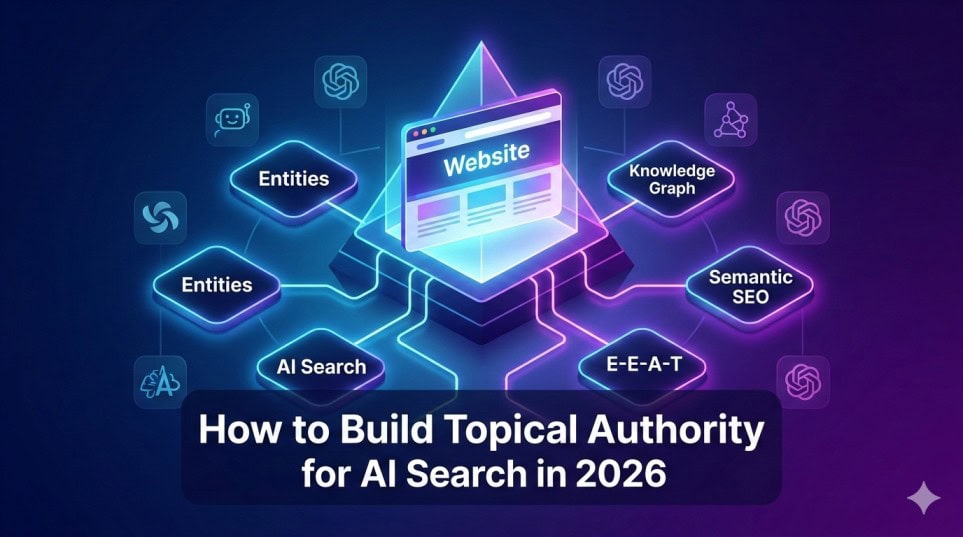
Search has changed.
Ranking on Google is no longer enough. In 2026, brands must be cited by AI systems — including Google AI Overviews, ChatGPT, Gemini, Claude, and Perplexity.
If you’re asking how to build topical authority AI search, you’re really asking:
How do I become the most trusted, extractable, and citable source in my niche?
If you’re still unclear about how traditional SEO differs from answer engines and generative systems, start here:
AEO vs SEO vs GEO: Key Differences Explained for Beginners (2025–26)
This guide provides a research-backed, systemized framework built for:
SEO
Answer Engine Optimization
Generative Engine Optimization
Knowledge Graph alignment
AI citation engineering
What Is Topical Authority in SEO?
Topical authority is the perceived expertise and depth a website demonstrates within a defined subject area.
Traditionally, it meant:
Publishing multiple related articles
Ranking across keyword clusters
Building backlinks
Covering subtopics comprehensively
But in 2026, topical authority is not just keyword clustering.
To understand the foundation of entity-driven optimization, read:
Semantic SEO Explained: 2026 Guide to AI Rankings
Semantic SEO is the bridge between traditional rankings and AI extractability.
How AI Search Defines Topical Authority Differently
AI systems do not simply rank content.
They:
Extract
Summarize
Cross-reference
Cluster entities
Cite sources
This is where Generative Engine Optimization (GEO) becomes critical.
If you want a complete breakdown of GEO and how it works, read:
What Is GEO in SEO? Generative Engine Optimization Explained
In AI search, topical authority is not keyword dominance.
It is entity graph dominance.
Why Topical Authority Matters More in 2026
AI Overviews and generative summaries reduce traditional clicks.
Authority now determines:
AI inclusion
Knowledge graph association
Brand recall in AI answers
Zero-click visibility
If you’re wondering whether AI systems will replace traditional SEO entirely, this explains the evolution:
AI SEO vs Traditional SEO: Can AI Replace SEO?
Topical authority is not optional in AI search.
It is survival.

Step-by-Step Framework to Build Topical Authority for AI Search
Introducing:
The AI Topical Authority Matrix™ (2026 Framework)
Built on five pillars:
Entity Mapping
Semantic Coverage
Structural Extractability
Trust Amplification
Citation Engineering
Content Clustering vs Entity Mapping
Traditional SEO uses keyword clustering.
AI search relies on entity relationships.
Before transitioning from keyword clusters to entity SEO systems, revisit this foundation:
Semantic SEO Explained: 2026 Guide to AI Rankings
Entity mapping connects:
Core Topic
→ Sub-Entities
→ Related Processes
→ Comparisons
→ FAQs
→ Case Studies
This creates semantic density that AI systems trust.
Internal Linking Architecture for AI Extraction
Internal links reinforce entity context.
Best practices:
Link subtopics to entity hubs
Use descriptive anchor text
Build a clear hierarchy
Reinforce entity relationships consistently
For a detailed technical walkthrough, see:
How to Optimize Website for AI Answers (AI Search Optimization Guide)
Internal linking is not just for crawlability.
It builds contextual confidence for AI extraction.
E-E-A-T Signals and AI Trust Layers
Authority requires layered trust.
Layer 1: Structured content clarity
Layer 2: Author credibility
Layer 3: Brand consistency
Layer 4: Reputation management
If your brand has negative or conflicting signals in search results, it weakens trust. Learn how to manage this here:
Negative Results on Google? Fix Your Online Reputation in 2026
AI systems evaluate consistency across the web.
Trust compounds.
Advanced GEO Optimization for AI Citations
Generative Engine Optimization requires:
Clear definitions
Unique frameworks
Structured comparisons
Extractable FAQs
Reinforced entity associations
If your goal is direct AI visibility and citations, study:
How to Get Your Website Cited by ChatGPT and AI Models
You should also understand the mechanics of answer engines specifically:
What Is Answer Engine Optimization (AEO)?
AI citation optimization is engineered clarity.
Case Study: Topical Authority Growth in 6 Months
Niche: AI SEO
Initial Traffic: 4,200/month
Initial Ranking Keywords: 180
Strategy:
Built entity map (32 sub-entities)
Published 18 in-depth articles
Strengthened internal links
Structured FAQs
Improved semantic reinforcement
Results:
Traffic: +146%
Keywords: 180 → 1,120
Featured Snippets: 2 → 17
AI Overview inclusion: 0 → 9 tracked queries
Perplexity AI visibility: Increased citation appearance
For Perplexity-specific optimization strategy, see:
How to Appear in Perplexity AI Search Results
PAA Optimization Section
How long does it take to build topical authority?
Typically 4–8 months with structured entity mapping and strong internal linking.
Does publishing more content increase topical authority?
Not alone. Structured, entity-connected content increases authority — not volume.
How many articles are needed for topical authority?
Most niches require 15–40 deeply interconnected pages built around core entities.
Is topical authority still relevant with AI search?
Yes. AI systems rely heavily on structured topical depth for citation decisions.
Can small websites build topical authority in 2026?
Yes. Niche dominance is easier than broad authority.
To combine topical authority with scalable growth, read:
How to Get Organic Traffic to Your Website in 2026 (Free Guide)
Conclusion
To master how to build topical authority AI search, you must:
Think in entities
Build semantic depth
Structure for extraction
Engineer citation probability
Strengthen trust signals
Authority in 2026 is structural.
When AI systems summarize your niche,
your brand should be the reference point.
FAQ Section
Question: What is topical authority in AI search?
Answer: Topical authority in AI search is entity dominance within a subject area, structured for AI extraction and citation.
Question: How does AI evaluate topical authority?
Answer: AI evaluates entity relationships, semantic depth, structural clarity, trust signals, and citation consistency.
Question: Is keyword clustering enough for AI search?
Answer: No. AI search relies more on entity mapping and semantic relationships than keyword repetition.
Question: How can I increase AI citation probability?
Answer: Create unique frameworks, define entities clearly, structure content for extraction, and reinforce entity connections internally.
Question: Does E-E-A-T affect AI search visibility?
Answer: Yes. Strong expertise, experience, authority, and trust signals increase AI citation confidence.
Leave a Reply