
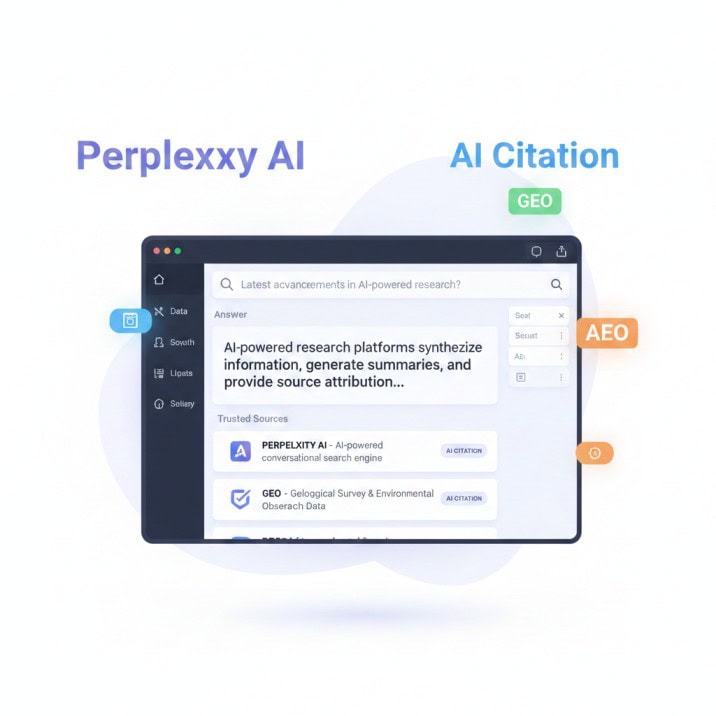
Perplexity AI is rewriting the rules of search. Millions of users now get direct answers — with citations — instead of clicking blue links. This guide covers Answer Engine Optimization (AEO), Generative Engine Optimization, and every technical and content strategy you need to get your website featured as a cited source.
- What Is Perplexity AI and Why Does It Matter?
- How Perplexity AI Finds and Cites Sources
- GEO vs. Traditional SEO: Key Differences
- How to Optimize Content to Appear in Perplexity AI Results
- Technical SEO Factors That Help Perplexity Crawl Your Site
- Building Authority and Trust Signals
- Best Content Formats for Perplexity Citations
- Keyword and Query Strategy for Perplexity AI
- PAA-Style Optimization: Answer the Questions People Ask
- Common Mistakes That Prevent Perplexity Citations
- How to Measure Your Perplexity Visibility
- FAQs
1. What Is Perplexity AI and Why Does It Matter?
Perplexity AI is an AI-powered answer engine that combines large language model (LLM) reasoning with real-time web search. Unlike Google, which returns a list of links, Perplexity delivers a synthesized, paragraph-form answer and then cites the specific web pages it pulled information from.
Launched in 2022 and growing at a staggering pace, Perplexity AI surpassed 100 million monthly active users in early 2025. It processes hundreds of millions of queries per month and is one of the fastest-adopted consumer AI products in history.
For content creators, marketers, and SEOs, this growth represents a fundamental shift. Your potential audience is no longer just searching on Google. They are asking Perplexity questions and reading synthesized answers. If your site is not being cited, you are invisible to this audience. If you want to go further, our complete guide on how to get your website cited by ChatGPT and other AI models covers the full multi-platform AI citation strategy.
Why Perplexity Citations Matter More Than a Ranking
When Perplexity cites your article, it does three things simultaneously. It displays a numbered footnote directly in the answer. It renders a preview card with your domain name and headline. And it links to your page as a source users can verify. This positions you as an authority — not just a result — in the eyes of the reader.
The downstream effect is significant: users who click through to cited sources are high-intent, already convinced of your relevance, and far more likely to engage deeply with your content than a typical organic search visitor.
Key Insight: Appearing in Perplexity AI results is not about gaming an algorithm. It is about producing genuinely authoritative content that an AI model can confidently summarize and attribute.
2. How Perplexity AI Finds and Cites Sources
To appear in Perplexity AI results, you first need to understand exactly how the engine discovers and selects content. Perplexity uses a multi-stage pipeline that involves web crawling, real-time retrieval, LLM synthesis, and citation ranking.
Stage 1: Web Crawling via PerplexityBot
Perplexity uses its own web crawler called PerplexityBot. This bot follows the same rules as Googlebot — it respects your robots.txt file, reads your sitemap, and indexes pages it can access. If you have blocked PerplexityBot (accidentally or intentionally), your content will never appear in its results.
Stage 2: Real-Time Retrieval Augmented Generation (RAG)
When a user submits a query, Perplexity does not rely solely on a pre-trained knowledge base. It runs a real-time search to retrieve the most current and relevant documents, then feeds those documents into an LLM as context. This process is called Retrieval Augmented Generation (RAG). To understand the full picture of how this affects your content strategy, see our detailed guide on how to optimize your website for AI answers.
This means Perplexity actively prefers fresh, regularly updated content. A well-maintained blog that publishes weekly has a structural advantage over static, outdated pages.
Stage 3: Source Selection and Citation Ranking
Not all retrieved pages get cited. Perplexity’s LLM selects pages that best answer the specific query, prioritizing content that is:
- Directly responsive to the user’s question
- Clearly structured with headings, definitions, and lists
- From domains with established topical authority
- Free of thin, duplicate, or ambiguous content
- Written with explicit factual claims (not vague generalizations)

How Perplexity Selects Sources: A Summary Table
| Factor | What Perplexity Looks For | Impact Level |
|---|---|---|
| Crawlability | PerplexityBot must be allowed in robots.txt | Critical |
| Content Freshness | Recently published or updated pages | High |
| Topical Authority | Domain expertise in the subject area | High |
| Answer Clarity | Direct, concise, quotable responses to queries | High |
| Structural Markup | Proper headings, lists, schema, definitions | Medium-High |
| Page Speed | Fast-loading, accessible pages | Medium |
| External Citations | Backlinks and references from other authoritative sources | Medium |
3. GEO vs. Traditional SEO: Key Differences
Generative Engine Optimization (GEO) is the practice of structuring, writing, and publishing content so that AI-powered answer engines like Perplexity, Google AI Overviews, and ChatGPT Browse can accurately extract, summarize, and cite your content in their generated responses.
Traditional SEO focuses on ranking signals: backlinks, keyword density, page authority, and click-through rate. GEO shifts the focus to extractability — can an LLM accurately pull a clean, citable answer from your page?
| Dimension | Traditional SEO | GEO (for Perplexity AI) |
|---|---|---|
| Goal | Rank #1 on Google SERPs | Get cited as a source in AI answers |
| Audience | Human searchers clicking links | AI models + users reading synthesized answers |
| Content Style | Keyword-rich, long-form | Question-answering, definition-first, structured |
| Success Metric | Organic traffic, SERP position | Citation frequency, source card appearances |
| Key Technical Signal | PageRank, Core Web Vitals | Crawlability, schema markup, RAG-friendliness |
| Content Freshness | Important but not critical for all queries | Critical — Perplexity actively prioritizes fresh content |
The good news: GEO and SEO are complementary, not competing — as we explore in depth in our guide to AI SEO vs. Traditional SEO. Content optimized for Perplexity AI citations will almost always perform better in traditional search as well, because the practices overlap heavily: clear structure, authoritative depth, and direct answers all serve both goals.
4. How to Optimize Content to Appear in Perplexity AI Results
This is the core of the guide. The following strategies are specifically designed to increase your probability of being cited by Perplexity AI when users ask questions in your niche.
4.1 Write Direct, Answer-First Content
The single most important writing change you can make is to answer the question in the first two sentences of every relevant section. Perplexity’s LLM scans for the most direct, quotable answer to a query. If your answer is buried in paragraph five after three introductory sentences, you will be skipped.
Think of each H2 heading as a question someone might ask. Then open that section with a direct, complete answer. Add context, depth, and examples afterward.
Example: Answer-Last vs. Answer-First Writing
| Answer-Last (Avoid) | Answer-First (Do This) |
|---|---|
| “Perplexity AI has grown significantly in recent years. Many users are now turning to AI-powered tools for research. If you think about how information was consumed before, it was quite different. Today, Perplexity AI is an answer engine.” | “Perplexity AI is an AI-powered answer engine that delivers synthesized, cited responses to user queries in real time. It combines web search with large language model reasoning to produce paragraph-form answers instead of blue links.” |
4.2 Use Structured Definitions
Perplexity is highly likely to cite pages that include clean, standalone definitions. Any time you introduce a concept, term, acronym, or framework in your content, write a dedicated definition block. Keep it to two to four sentences. Make it self-contained so it reads clearly even when extracted out of context.
4.3 Organize Content Around Questions
Structure your article headings as questions that your target audience would naturally type or speak into Perplexity. Instead of a heading like “Benefits of Keyword Research,” write “What Are the Benefits of Keyword Research?” This directly matches the question-answering format Perplexity is built on.
4.4 Include Specific, Verifiable Data Points
Perplexity’s LLM strongly favors content that includes concrete facts, statistics, and numbers. Vague claims like “many companies use this strategy” are far less likely to be cited than specific claims like “according to a 2024 BrightEdge report, 68% of enterprise marketers have begun investing in GEO strategies.”
Whenever possible, include: percentages, dates, named studies or reports, specific tool names, step counts, and numeric comparisons. These give the AI model concrete, citable information.
4.5 Write in Crisp, Quotable Sentences
AI models extract and quote sentence-level content. Write sentences that are complete, factually accurate, and meaningful on their own. Avoid long, meandering compound sentences. A good test: read any single sentence in your article in isolation. Does it communicate something clear and useful by itself? If not, break it up.
4.6 Use Comparison Tables, Numbered Lists, and Step-by-Step Guides
Structured formats like tables and numbered steps are among the most frequently cited content types in AI answer engines. They are visually scannable, logically organized, and easy to extract. Any process, comparison, or ranked list in your content should be formatted as a table or ordered list rather than buried in a paragraph.
4.7 Cover Topics Comprehensively — Then Add Unique Insight
Perplexity values depth. An article that covers a topic superficially across 500 words will consistently lose to a thorough piece that addresses every angle of the subject. However, comprehensiveness alone is not enough. The content that earns the most citations also includes a unique perspective, original data, or a distinctive framework that cannot be found verbatim elsewhere.
5. Technical SEO Factors That Help Perplexity Crawl Your Site
Even the best-written content cannot appear in Perplexity AI results if the platform’s crawler cannot access and index your pages. Technical optimization is the non-negotiable foundation.
- Allow PerplexityBot in Your robots.txt
Check your robots.txt file (accessible at yourdomain.com/robots.txt) and ensure you have not blocked PerplexityBot. You can explicitly allow it with:
User-agent: PerplexityBot / Allow: /. Many sites that block all unfamiliar bots inadvertently exclude Perplexity’s crawler. - Submit a Clean XML Sitemap
A well-maintained XML sitemap helps PerplexityBot discover all of your important pages quickly. Make sure your sitemap is referenced in your robots.txt and submitted to Google Search Console. Keep it updated automatically through your CMS.
- Implement Schema Markup (Structured Data)
Schema markup is JSON-LD code that tells AI crawlers exactly what type of content a page contains. For AI citation optimization, the most valuable schema types are Article, FAQPage, HowTo, and BreadcrumbList. These help Perplexity categorize and extract your content with precision.
- Optimize Core Web Vitals and Page Load Speed
Slow pages create friction for crawlers. Aim for a Largest Contentful Paint (LCP) under 2.5 seconds, a Cumulative Layout Shift (CLS) score below 0.1, and an Interaction to Next Paint (INP) under 200ms. Use Google PageSpeed Insights to diagnose and fix performance issues.
- Ensure Mobile Responsiveness and Clean HTML
Perplexity’s crawler reads your page’s HTML. Ensure your content is in clean, semantic HTML tags — use real heading elements (H1–H4), paragraph tags, and list elements rather than styled divs. Avoid JavaScript-rendered content that may not be crawled.
- Use HTTPS and Secure Your Site
An SSL certificate is a baseline requirement for trust. Both AI crawlers and traditional search engines deprioritize non-HTTPS pages. Ensure your site has a valid certificate and that all internal links resolve to HTTPS URLs.
- Eliminate Duplicate Content and Thin Pages
Duplicate content confuses AI models about which page to cite. Use canonical tags to specify the preferred version of any page that has duplicates. Merge or delete thin pages (under 300 words) that do not provide standalone value, as these dilute your domain’s perceived authority.
6. Building Authority and Trust Signals for Perplexity AI
Perplexity does not operate with Google’s explicit PageRank algorithm, but domain authority and online trustworthiness still influence which sources get cited. The platform consistently surfaces content from well-established, cited, and referenced sources over unknown or unverified domains.
E-E-A-T: Experience, Expertise, Authoritativeness, Trustworthiness
Google’s E-E-A-T framework, while designed for traditional search quality, maps almost perfectly onto what AI citation engines look for. Perplexity favors content where the author’s expertise is evident and verifiable.
- Include a detailed author bio with credentials, experience, and professional links
- Link to primary sources, research studies, and industry reports within your content
- Add publication dates and update timestamps to every article
- Build an About Us page that clearly identifies your organization’s expertise and mission
- Include a clear editorial policy or content review process for your site
- Display your physical address, contact information, and privacy policy (YMYL sites especially)
Earning Backlinks from Authoritative Sources
While Perplexity does not rank by PageRank, backlinks are a proxy for real-world authority. When academic institutions, news publications, industry associations, and respected blogs link to your content, those citations signal that humans with editorial judgment have found your work worth referencing. This reputation carries weight with AI engines.
Focus your link-building efforts on creating resources that others naturally want to cite: original research, comprehensive guides, unique datasets, and expert interviews. Avoid link schemes that inflate your backlink profile without genuine editorial endorsement.
Establishing Topical Authority
Perplexity is more likely to consistently cite a site that covers a specific topic deeply across multiple interlinked pages than a site that covers many topics superficially. Build a content cluster strategy: create one comprehensive pillar page for your core topic, then publish multiple supporting articles around specific subtopics. Link these articles together to signal to crawlers that your site is a deep resource on the subject.
7. Best Content Formats for Perplexity AI Citations
Not all content types are equally citation-friendly. Based on how Perplexity’s RAG pipeline works, the following formats earn citations at significantly higher rates.
| Content Format | Why Perplexity Cites It | Best For |
|---|---|---|
| How-To Guides | Numbered steps are directly quotable; clear process structure | Technical tutorials, process walkthroughs |
| Definition Articles | Concise, authoritative definitions are exactly what AI needs | Concept explainers, glossary pages |
| Comparison Guides | Tables offer structured, extractable data | Tool comparisons, strategy contrasts |
| Statistics Roundups | Data-rich content is highly citable by nature | Industry reports, benchmark articles |
| Expert Interviews | Named experts add credibility and unique insights | Thought leadership, niche authority content |
| FAQ Pages | Question-answer format mirrors how users query AI | Product pages, topic hubs |
| Case Studies | Specific, verifiable outcomes are highly authoritative | Business and marketing content |
What to Avoid
Content formats that rarely earn Perplexity citations include listicles without context or depth, opinion pieces without supporting evidence, landing pages focused purely on conversion copy, and content written primarily for keyword density rather than genuine information value.
8. Keyword and Query Strategy for Perplexity AI
Perplexity users tend to phrase their searches as full questions or complete sentences rather than the two-to-three word fragments common in Google searches. This means your keyword strategy needs to shift toward conversational, question-based, and long-tail queries.
Target Conversational Long-Tail Queries
Instead of optimizing for “Perplexity AI SEO,” build content around the full questions users actually ask:
- “How do I get my website to show up in Perplexity AI answers?”
- “What makes a website get cited by Perplexity AI?”
- “How is Perplexity AI different from Google Search for SEO?”
- “Can I submit my website to Perplexity AI for indexing?”
Use Semantic and LSI Keywords Naturally
Perplexity’s LLM understands semantic relationships between concepts. Stuffing your primary keyword repeatedly does not help. Instead, naturally integrate related terms: RAG, answer engine optimization, AI citations, generative AI search, LLM content optimization, PerplexityBot, knowledge graphs, topical authority, and content freshness. To master this approach, read our full breakdown of Semantic SEO for AI rankings in 2026. These semantic signals help the AI understand your content’s full scope.
Map Keywords to User Intent
Every keyword you target should map to a clear user intent: informational (learning), navigational (finding a specific resource), or commercial investigation (comparing options before a decision). Perplexity users are overwhelmingly in informational or commercial investigation mode. Structure your content to serve both by providing thorough explanations followed by actionable guidance.
9. PAA-Style Optimization: Answer the Questions People Ask
People Also Ask (PAA) boxes in Google and the question-based results in Perplexity both reward content that directly answers real user questions. Embed PAA-style Q&A blocks throughout your article to increase the chance of being cited for specific question-form queries.
Perplexity AI does not maintain a standalone search index the way Google does. Instead, it uses a hybrid approach: it has its own crawler (PerplexityBot) that indexes content, and it also integrates with external search APIs like Bing to retrieve real-time web results. This combination allows it to serve both cached and freshly crawled content.
There is no guaranteed timeline. Pages that are already indexed by Bing or Google and accessible to PerplexityBot can appear in Perplexity results within days of publishing. New domains with no prior authority may take weeks to months to build enough credibility for consistent citation. Regularly publishing high-quality, crawlable content accelerates the process significantly.
As of 2025, Perplexity AI does not offer a direct URL submission tool similar to Google Search Console. The best approach is to ensure your site is indexed by Google and Bing (which Perplexity uses as a supplemental data source), allow PerplexityBot in your robots.txt, and publish authoritative content that earns organic citations. Perplexity has launched a publisher program for media partnerships, but this is separate from general crawl indexing.
Perplexity AI can and does cite YouTube videos, Reddit threads, and select social platforms, particularly when those sources contain unique first-person experiences or highly specific information not found in formal articles. However, traditional web pages, news sites, academic content, and authoritative blogs remain the most consistently cited source types for factual queries.
HTTPS is not a hard requirement, but it is a strong trust signal. Both PerplexityBot and the LLMs powering Perplexity’s synthesis layer favor secure, trustworthy domains. Non-HTTPS sites are perceived as less credible and are less likely to be selected as citations, particularly for authoritative or YMYL (Your Money or Your Life) queries.
10. Common Mistakes That Prevent Perplexity Citations
Even well-intentioned content strategies can undermine your visibility in Perplexity AI results. These are the most common errors to avoid.
| Mistake | Why It Hurts | Fix |
|---|---|---|
| Blocking PerplexityBot in robots.txt | Makes your content completely invisible to Perplexity | Explicitly allow PerplexityBot in your robots.txt |
| Writing long-winded introductions | Buries the answer; AI skips to more direct sources | Answer first, add context second |
| No schema markup | Crawler cannot categorize content type accurately | Add Article, FAQPage, and HowTo schema |
| Vague, unverifiable claims | AI models need specific, citable facts | Include data, stats, named sources |
| Publishing thin, short content | Perceived as low authority; rarely cited | Target comprehensive depth (2,000–5,000 words) |
| Keyword stuffing | Reduces readability; AI models detect unnatural text | Write naturally; focus on semantic coverage |
| Ignoring content freshness | Perplexity prioritizes current information | Set a regular update schedule for key articles |
| No clear author attribution | Reduces E-E-A-T signals and trustworthiness | Add full author bios with credentials |
| Slow page load speed | Impairs crawlability and user experience | Optimize images, enable caching, use CDN |
11. How to Measure Your Perplexity AI Visibility
Unlike Google Search Console, Perplexity does not yet provide a dedicated webmaster tool that shows you how often your site is cited. However, there are several practical ways to track and measure your visibility.
Method 1: Direct Queries in Perplexity
The most direct approach: open Perplexity.ai and ask the questions your content is designed to answer. Check whether your domain appears in the source citations on the right panel. Do this regularly for your top 20 to 30 target queries to spot trends.
Method 2: Monitor PerplexityBot in Server Logs
Your web server logs show every bot crawling your site. Filter for requests from PerplexityBot to see which pages are being crawled, how frequently, and whether crawl frequency is increasing over time. Growing crawl activity generally correlates with growing citation potential.
Method 3: Referral Traffic in Google Analytics
When users click a cited source link in Perplexity, the traffic appears as a referral visit from perplexity.ai in Google Analytics 4. Set up a referral traffic report filtered to perplexity.ai. Even small amounts of this traffic confirm you are being cited. Track this month over month. For a broader picture of how to grow all forms of organic traffic to your website in 2026, our free SEO guide covers every channel in detail.
Method 4: Use Third-Party AI Visibility Tools
Emerging tools specifically designed for AI citation tracking — such as Profound, Brandwatch AI Insights, and others entering the market in 2025 — allow you to systematically monitor when your brand or content is referenced across multiple AI answer engines simultaneously. These are especially valuable for enterprise-level content programs.
Method 5: Brand Mention Tracking
Set up Google Alerts or use tools like Brand24 or Mention.com to track when your domain or brand name appears in content published by others. Perplexity’s citations, when users share AI-generated answers, often contain your domain name and can be surfaced through brand monitoring.
12. FAQs:
No. Perplexity AI and ChatGPT’s browsing feature are distinct products. Perplexity is built from the ground up as an answer engine with citations as a core feature. ChatGPT’s search capability is an extension added to a conversational assistant. The underlying models, crawling infrastructure, and citation behavior are different. Optimizing for one does not guarantee visibility in the other, though many GEO best practices apply to both.
Not necessarily. Perplexity regularly cites niche sites with moderate authority if those sites provide the most specific, authoritative answer to a query. A highly specialized blog with deep coverage of a narrow topic can outperform a high-DA generalist site for specific long-tail queries. Topical authority and answer quality matter more than raw domain metrics.
For rapidly evolving topics — technology, marketing, finance, health — review and update core articles at minimum every three to six months. Add new data, update statistics, and revise any outdated information. Change your published or “last updated” date when you make meaningful revisions. Perplexity’s real-time retrieval system actively favors recently updated content for competitive queries.
Publishing on high-authority platforms like LinkedIn Articles or Medium can result in those pieces being cited by Perplexity, particularly if your own domain has low authority. However, this strategy has a significant downside: the citation benefit goes to LinkedIn or Medium, not your domain. For long-term brand and domain authority building, always prioritize publishing on your own website and use syndication platforms as supplementary distribution channels only.
Social proof — comments, shares, forum discussions, and reviews referencing your content — creates secondary citation trails that AI crawlers can detect. When your content is referenced across Reddit, industry forums, and social platforms, it signals to AI engines that real humans find your work credible. This is not a direct ranking factor but contributes to your overall digital footprint and authority perception.
Using AI as a drafting or research aid is acceptable and efficient. However, publishing purely AI-generated content at scale without human review, unique insight, or expert validation is counterproductive. Perplexity — and all major AI citation engines — are increasingly trained to detect low-quality, undifferentiated AI content. Pages that add genuine human expertise, original data, or unique analysis earn far more citations than generic AI-produced articles.
Key Takeaways: How to Appear in Perplexity AI Results
Appearing in Perplexity AI search results requires a deliberate combination of content quality, technical optimization, and authority building. Here is a summary of the highest-impact actions you can take today.
- Allow PerplexityBot in your robots.txt — this is the non-negotiable first step
- Write answer-first content— place your direct answer in the first two sentences of every section
- Add schema markup— implement Article, FAQPage, and HowTo schema across your site
- Build topical authority— create content clusters rather than isolated articles
- Include specific data— cite studies, include statistics, name your sources
- Update content regularly— Perplexity prioritizes freshness; review key pages every quarter
- Optimize for questions— structure headings as questions your audience actually asks
- Track referral traffic from perplexity.ai— measure what is working and scale it
- Establish author credibility— detailed bios, credentials, and editorial standards signal trustworthiness
- Ensure technical crawlability— fast pages, clean HTML, HTTPS, and no crawl blocks
The era of AI answer engines is not coming — it is already here. Perplexity AI is how tens of millions of people get information daily, and that number is growing every month. The content strategies that win citations today will define which websites remain visible, trusted, and authoritative as search continues to evolve. Start implementing these practices now, and position your site as the source that AI models reach for first.
Leave a Reply