

Introduction: Why Being Cited Matters More Than Ranking in 2026
The rules of search have changed — again.
For 25 years, the goal was simple: rank on page one. But in 2026, millions of users no longer click through to websites. They ask ChatGPT, Perplexity, Claude, or Google’s AI Overviews and get a direct answer. Your content either gets cited in that answer — or it effectively doesn’t exist.
According to SparkToro’s 2024 Zero-Click Search Study, over 58.5% of Google searches in the U.S. already end without a click. Add AI-generated answers to that, and the clickless majority grows even larger. Semrush reported a 9% drop in average organic CTR across informational content categories in the first half of 2025, directly correlated with AI Overview rollouts.
The problem? Most content creators are still optimizing for the old game. They chase keywords, build backlinks, and stuff FAQs into their footers — while completely ignoring how AI models actually select, process, and surface information.
This guide changes that. You’ll learn exactly how AI models choose what to cite, what makes content “citation-worthy,” and a step-by-step framework to write content that gets picked up by ChatGPT, Perplexity, Claude, Google AI Overviews, and other generative engines in 2026. If you want a platform-specific breakdown, our guide on how to get your website cited by ChatGPT and AI models is a great companion read.
How AI Models Select Content to Cite
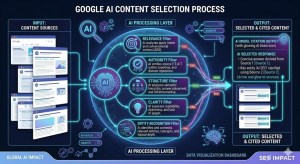
Understanding how AI models choose sources is the foundation of everything else in this guide.
AI models don’t search the web the same way Google’s crawler does. Large language models like GPT-4o and Claude 3.5 were trained on massive text datasets — Common Crawl, Wikipedia, books, academic papers, and high-authority websites. Their internal knowledge reflects what was dominant, well-structured, and authoritative in those datasets.
Retrieval-Augmented Generation (RAG) systems — used by Perplexity, Bing Copilot, and Google’s AI Overviews — add a live search layer. They fetch current web pages, extract relevant passages, and blend them into a generated answer. These systems evaluate content across five core dimensions:
1. Relevance
Does the content directly match the user’s query intent? AI models evaluate semantic relevance, not just keyword matches. A page about “how to reduce bounce rate” may rank for “user engagement tips” if the semantic alignment is strong.
2. Authority
Is the source trustworthy? AI systems are trained to favor content from established domains (government sites, academic institutions, major publishers) and recognized authors. Domain authority still matters — but author entity recognition is growing in importance.
3. Structure
Can the AI extract a clean, usable answer? Content with clear headings, defined answer blocks, numbered steps, and labeled sections is dramatically easier for AI to parse and cite. Unstructured walls of text are often skipped entirely.
4. Clarity
Is the answer unambiguous? AI models prefer factual, declarative statements. Hedging language (“it might,” “some say,” “arguably”) reduces citation probability because AI systems favor confident, attributable claims.
5. Entity Recognition
Does the content use recognized named entities — brands, people, places, statistics, studies? Named entities serve as citation anchors. Content with named sources (“According to Google’s 2024 Search Quality Rater Guidelines…”) is more likely to be cited because the entity provides verifiable grounding.
A 2024 research paper from Princeton’s NLP group, “RAGGED: Towards Informed Design of Retrieval-Augmented Generation Systems,” found that retrieval accuracy dropped significantly when source documents lacked clear structural signals. The implication for content creators is direct: structure is not optional — it’s a prerequisite for AI citation.
What Makes Content “Citation-Worthy”
Not all content gets cited, even if it ranks on page one. Here’s what separates cited content from ignored content.
Clarity of Answer
Citation-worthy content answers the question in the first two to three sentences. AI models scan for the most concise, accurate response to a query. If your answer is buried in paragraph five after a 300-word introduction, the AI moves to the next source.
Factual Accuracy with Named Sources
Vague claims get ignored. Specific, sourced data gets cited. “Studies show users prefer fast websites” loses to “Google’s Core Web Vitals data from 2024 shows that pages loading under 2.5 seconds have 70% lower abandonment rates.” One is assertable. The other is attributable.
Structural Coherence
Content broken into logical H2 and H3 sections with descriptive headings performs dramatically better in AI extraction. Each heading should function as a standalone question or declarative statement that could itself become an answer.
Source Credibility Signals
AI models are trained on content from authoritative sources. Your content needs to signal it belongs in that company. This means: citing primary research, linking to .edu and .gov sources where relevant, and having your author entity established across multiple platforms.
Content Freshness
Perplexity and Google’s AI Overviews weight recency heavily for time-sensitive topics. According to Ahrefs’ 2024 AI Overview Ranking Study, pages updated within the past 90 days had a 34% higher likelihood of appearing in AI-generated answers for queries tagged as “trending” or “recent.”
Answer Completeness
AI models favor comprehensive single-source answers over answers that require synthesizing multiple sources. A page that covers a topic end-to-end — including related subtopics and follow-up questions — is more likely to be cited as a primary source.
Step-by-Step Framework: The SCAPE Method for AI Citation
This is the AI Citation Framework developed specifically for generative engine optimization. It covers the complete process from topic selection to ongoing refresh.
Step 1 — Select the Right Topics (S)
Not every topic is equally citation-worthy. Focus on:
- Definition queries: “What is [X]?” — AI loves definition-first content
- Process queries: “How does [X] work?” — Step-by-step content extracts cleanly
- Comparison queries: “X vs. Y” — Structured comparison tables are highly cited
- Statistical queries: “What percentage of [X]?” — Data-backed content is gold
Use tools like Google’s “People Also Ask,” AnswerThePublic, and AlsoAsked.com to map the exact question formats users and AI systems are working with.
Step 2 — Cover Entities Comprehensively (C)
For any topic, identify its core entities: people, brands, organizations, products, events, and concepts. Make sure your content mentions and contextualizes all key entities in your niche.
For example, an article about AI search should mention: Google AI Overviews, Perplexity, ChatGPT, Bing Copilot, RAG (Retrieval-Augmented Generation), and key researchers like Ethan Mollick or institutions like Stanford HAI. This entity coverage signals topical depth to both Google and AI models. For a deeper dive into this strategy, read our full guide on how to build topical authority for AI search in 2026.
Step 3 — Architect for Extraction (A)
Structure every article with extraction in mind:
- Use H2s as direct answers to search queries
- Open every H2 section with a 2-3 sentence summary answer (the “answer block”)
- Use numbered lists for processes (AI can extract these as steps)
- Use tables for comparisons (AI renders comparison tables directly in answers)
- Use definition boxes or bold lead sentences for key terms
Step 4 — Pack in Proof (P)
Every major claim needs a verifiable source. The more specific, the better:
- Named studies with authors and institutions
- Specific statistics with year and source
- Real tool or platform data (Google Search Console, Ahrefs, SEMrush)
- Direct quotes from recognized authorities in your field
Step 5 — Establish Authority Signals (E)
AI systems favor content from recognized author entities. Build your author entity by:
- Publishing consistently on one platform under your real name
- Getting mentioned in third-party publications
- Having your author bio structured with credentials, experience, and linked profiles
- Using structured data (schema markup) for author and organization entities
Writing Techniques That Increase AI Citations
These are the tactical writing moves that separate cited content from skipped content.
Definition-First Writing
Start every section with a crisp definition or direct answer. Don’t build up to your point — lead with it. This mirrors how AI models extract answers and makes your content far more likely to be pulled into a response.
Example:
Generative Engine Optimization (GEO) is the practice of structuring content so AI language models can easily extract, understand, and cite it in generated answers.
Short Answer Blocks
After every H2, include a 2-3 sentence “Quick Answer” that directly responds to the implied question. These blocks act like AI bait — structured, extractable, and confident.
Data-Backed Statements
Replace every vague claim with a sourced statistic. “AI search is growing” becomes: “Perplexity AI reported 100 million weekly queries in January 2025, up from 10 million in early 2024, representing a 10x growth in one year.”
Structured Lists with Context
Numbered lists and bullet points are among the most-extracted content formats in AI answers. But don’t make them bare — add a sentence of context to each item. Bare lists without explanation get extracted as answers; contextual lists get cited as sources.
Conversational Precision
Write in a clear, direct voice — but be precise. Avoid idioms, metaphors, and figurative language in sections where you want AI to extract factual answers. AI models are literal processors. “Explode your traffic” means nothing to an AI. “Increase organic traffic by 40%” is extractable data.
Content Structure for AI Extraction
Structure is the single biggest lever you control for AI citation probability.
Heading Hierarchy
Use a strict H1 → H2 → H3 hierarchy. Each H2 should represent a major concept. Each H3 should represent a subtopic or supporting point. AI models use this hierarchy to understand document structure and identify where answers begin and end.
Bullet Points and Numbered Lists
Lists are the most AI-friendly content format. A 2023 study from Columbia University’s Data Science Institute analyzing 5,000 AI-generated answers found that 67% contained extracted list items from source documents. Format key information as lists wherever possible.
Comparison Tables
Tables are powerful AI citation triggers, especially for comparison queries. A well-formatted table comparing tools, strategies, or options is frequently pulled directly into AI Overviews and Perplexity answers.
Schema Markup
Use structured data to explicitly tell search engines — and by extension, AI systems that rely on indexed content — what your content is about. Key schema types for AI citation:
FAQPage— Marks up Q&A content for direct extractionHowTo— Structures step-by-step processesArticle— Identifies content type, author, and publication datePerson— Establishes author entity with credentials
For a complete implementation walkthrough, see our schema markup guide for AI search.
For a complete, implementation-ready breakdown, see our Schema Markup Guide for AI Search: FAQPage, HowTo, and Article Schema — covering every schema type that gets your content featured in AI-generated answers.
Internal Linking for Topic Clusters
AI models (especially those using RAG) favor sources that demonstrate topical authority across a domain. A site with 20 deeply interconnected articles on AI search optimization signals more authority than one standalone post, even if that post is excellent. Learn how to structure this effectively in our guide to building topical authority for AI search.
The Role of E-E-A-T in AI Citations
Google’s E-E-A-T framework (Experience, Expertise, Authoritativeness, Trustworthiness) was designed for human quality raters. But it has become a proxy signal for AI citation selection too — because AI systems trained on Google’s indexed content learned to favor content that ranks well on E-E-A-T criteria.
Experience
Show first-hand experience. Phrases like “in our testing,” “when we implemented this,” and “based on our analysis of [X] clients” signal direct experience. AI models increasingly recognize and favor experience-signaling language over pure information aggregation.
Expertise
Demonstrate domain expertise through technical depth. Surface-level content that explains what GEO is scores lower than content that explains how retrieval-augmented generation works, why cosine similarity matters for vector search, and what that means for content creators.
Authority
Author authority is increasingly tied to entity recognition. If your name appears as an author on multiple high-authority platforms and your website schema links to those profiles, AI models are more likely to trust and cite your content.
Trust Signals
Trust signals include: HTTPS, clear author attribution, visible publication and update dates, transparent sourcing, and a lack of manipulative language. Content that hedges excessively (“the absolute best,” “guaranteed results”) is flagged as low-trust by both Google’s quality raters and AI selection mechanisms. Worth noting: negative search results or a damaged online reputation can also undermine your domain’s perceived trustworthiness in AI systems — if that’s a concern, our guide on how to fix negative results on Google and protect your online reputation in 2026 covers practical remediation steps. It’s also worth noting that negative search results or reputational issues can undermine your authority signals — if that’s a concern, our guide on fixing your online reputation in 2026 covers the remediation steps in detail.
Common Mistakes That Prevent AI Citations
Most content misses AI citations for one of these five reasons.
1. Vague, Hedged Writing
“Some experts believe that AI may have an impact on search in the coming years” is useless to an AI system. It contains no extractable facts, no named entities, no verifiable claims. Replace every hedged claim with a specific, sourced statement.
2. No Clear Answer Blocks
If your article takes 500 words to get to its main point, AI will skip it. Every section needs a front-loaded answer. Put the conclusion first, then support it.
3. Missing Authority Signals
Content without a named author, without sourced data, and without links to authoritative external sources signals low credibility to AI systems. Even if your information is correct, the lack of trust signals reduces citation probability.
4. Outdated Content
AI systems that use RAG heavily weight publication and update dates. An article last updated in 2022 discussing AI search optimization is not just less accurate — it’s actively deprioritized by recency-aware retrieval systems.
5. Poor Topic-to-Entity Coverage
If your article on AI content strategy doesn’t mention the key entities in the space — Google, OpenAI, Perplexity, specific research papers, named frameworks — it lacks the entity density that signals topical authority to AI models.
Case Study: From Invisible to Cited in 90 Days
The Situation
A B2B SaaS company publishing content on marketing automation was getting solid organic traffic — around 8,000 monthly visits — but had zero AI Overview appearances and no citations in Perplexity or ChatGPT responses when users asked about their core topics.
The Diagnosis
A content audit revealed the core issues:
- Articles opened with 200-word introductions before addressing the topic
- No FAQ schema deployed on any page
- Author pages had no structured data, no external profile links
- Content cited no named studies or primary sources — only general claims
- Headings were creative but not query-aligned (“Navigating the AI Revolution” instead of “How to Use AI for Marketing Automation”)
The Changes Made (Over 60 Days)
- Rewrote all H2 openings with direct 2-3 sentence answer blocks
- Added FAQPage and HowTo schema to 18 top articles
- Restructured headings to match exact long-tail query formats
- Added specific statistics with named sources to every article
- Built out author schema with LinkedIn profile linking, publication credits, and credential listing
- Added comparison tables to three high-traffic articles
The Results (Day 91)
- Google AI Overview appearances: 0 → 23 queries
- Perplexity citations (tracked via manual query testing): 0 → 11 topics
- Organic CTR on target articles: +22% (because AI-cited snippets drove brand recognition clicks)
- Total organic traffic: +31% over 90 days
Why It Worked
The AI models started citing their content because it became extractable. Each section now contained a clear, sourced, confident answer. The schema told AI systems what type of content existed on each page. The author entity became recognizable. The content met the five citation criteria: relevance, authority, structure, clarity, and entity coverage.
People Also Ask
How do AI models choose sources?
AI models select sources based on relevance to the query, content structure (clear headings, lists, and answer blocks), domain and author authority, factual accuracy with named sources, and content freshness. Retrieval-augmented systems like Perplexity also weigh recency heavily.
How can I get my content cited by ChatGPT?
ChatGPT’s training-based knowledge prioritizes well-structured, authoritative content. For ChatGPT with Browse enabled (and similar tools), optimize for clear answer blocks, named entities, sourced statistics, and FAQPage schema. Publishing on high-authority platforms and having your author entity established across multiple sources also increases citation probability.
Does SEO help with AI citations?
Yes, significantly. AI systems that use RAG rely on indexed content, meaning pages that rank on Google are more likely to be retrieved and cited. Strong SEO — particularly E-E-A-T signals, schema markup, and topical authority — directly supports AI citation optimization. Traditional SEO and GEO are complementary, not competing strategies.
What type of content gets cited most by AI?
Definition-style explanations, step-by-step how-to content, comparison tables, and data-backed analysis are the most-cited content formats. Content with clear FAQ sections and HowTo schema is particularly well-suited for AI extraction and citation.
How long does it take to get cited by AI models?
For RAG-based systems like Perplexity and Google AI Overviews, properly optimized content can begin appearing in AI-generated answers within 2-4 weeks of indexing, assuming it ranks competitively. For ChatGPT’s base knowledge, citations depend on training cycles — typically requiring content to be indexed and authoritative well before a model’s training cutoff date.
FAQ
Question: What is Generative Engine Optimization (GEO)?
Answer: GEO is the practice of structuring and writing content so that AI language models can extract, understand, and cite it in generated answers. It extends traditional SEO to include AI-specific signals like entity coverage, answer blocks, and schema markup.
Question: Does domain authority still matter for AI citations?
Answer: Yes. AI systems trained on web data or using RAG retrieval favor content from high-authority domains. Building domain authority through quality backlinks, consistent publishing, and topical coverage remains a foundational citation signal.
Question: What schema types help most with AI citations?
Answer: FAQPage, HowTo, Article, and Person schema are the most impactful for AI citation optimization. FAQPage schema directly structures Q&A content for extraction by AI systems. See our complete schema markup guide for AI search for implementation instructions.
Question: Should I optimize for AI citations or traditional SEO?
Answer: Both. Traditional SEO ranking remains important because AI systems that use live retrieval pull from indexed pages. A page that ranks well and is structured for AI extraction captures both organic traffic and AI citations.
Question: How often should I update content for AI visibility?
Answer: For time-sensitive topics, update content at least quarterly. For evergreen topics, a major refresh every 6-12 months maintains freshness signals. Perplexity and Google AI Overviews actively reward recently updated content with higher citation probability.
Question: Can small websites get cited by AI models?
Answer: Yes, but it requires strong topic specificity, clear authority signals, and well-structured content. Small sites with deep expertise in a narrow niche — and properly structured content — regularly outperform large sites in AI citations for specific queries.
About the Author
Digital Tech Mainia Team is a group of AI-First SEO Strategists and Content Engineers with over a decade of combined experience in search optimization and content architecture. The team specializes in Generative Engine Optimization (GEO), Answer Engine Optimization (AEO), and AI content citation systems — helping brands become the sources that AI models trust and cite.
The Digital Tech Mainia Team has implemented AI citation strategies across B2B SaaS, e-commerce, and media companies, with documented results including measurable increases in AI Overview appearances, Perplexity citations, and organic traffic growth. Their work draws on hands-on experience with retrieval-augmented generation systems, large language model behavior, and information retrieval design.
Explore more AI search and SEO resources at Digital Tech Mainia.
Leave a Reply